The Inbound vs Outbound Debate is a Distraction: Why B2B Companies Need Both
Estimated reading time: 10 minutes
I've watched this debate play out in every sales community, LinkedIn thread, and founder Slack group for years. And I've come to believe most people are arguing about the wrong thing.
Team Inbound believes outbound is spam. Desperate. That guy at the conference who corners you near the coffee station and won't stop pitching.
Team Outbound thinks inbound is a luxury for companies with time to burn. Good luck waiting 9 months for SEO to kick in while your pipeline bleeds out.
Both sides are half right. And completely missing the point.
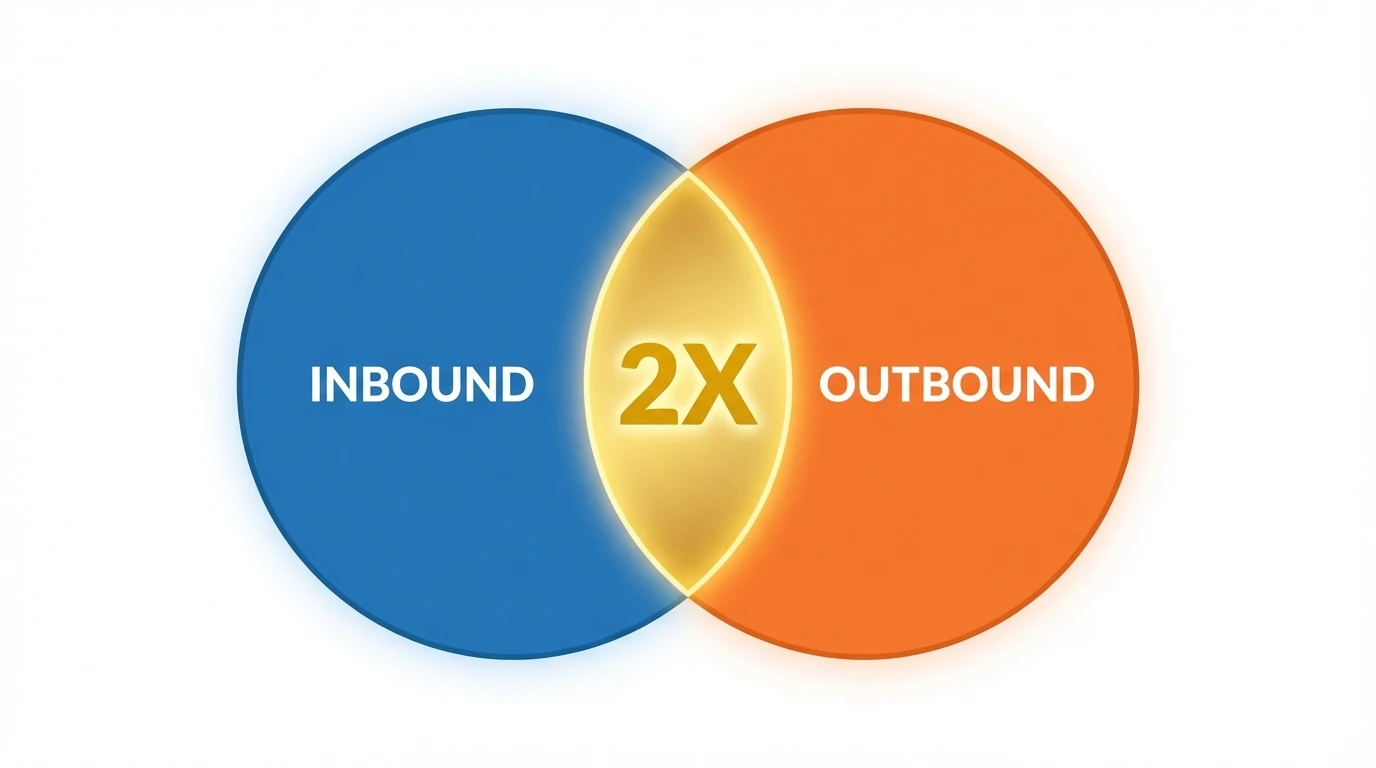
The data tells a different story: companies that integrate both approaches see 2x the revenue growth of inbound-only companies. The real question: whether you're executing either one well enough to matter.
The Case for Inbound (And Why It's Compelling)
Inbound marketing has earned its reputation. The numbers are genuinely impressive:
Conversion quality is higher. Inbound leads convert at 14.6% compared to 1.7% for cold outbound. When someone comes to you through content, SEO, or thought leadership, they've already self-qualified. They have a problem, they've been researching solutions, and they've decided you might be worth talking to.
Cost efficiency is real (once the engine is running). Inbound leads cost $75-150 on average, while outbound leads run $200-500. But this comparison assumes a mature inbound program. Once that flywheel spins, the math works: after 5 months of consistent inbound marketing, average cost per lead drops by 80%. Content compounds. Cold calls don't.
Trust is built-in. 73% of B2B buyers trust thought leadership more than traditional marketing materials. When a prospect reads your content before talking to sales, you're starting from credibility, not zero.
Sales teams prefer it. 59% of sales reps prefer working inbound leads compared to just 16% who favor outbound. Inbound leads come with context, intent, and fewer objections.
The appeal is obvious. Build content, optimize for search, post on LinkedIn, and leads come to you. Cleaner. More sustainable. Less desperate.
But there are real limitations that the "just create great content" crowd glosses over.
The Hidden Limitations of Inbound
You Have Zero Control Over Who Sees Your Stuff
This is the fundamental problem with inbound that nobody talks about directly.
You can write the best content in the world, but if your ideal buyer isn't active on LinkedIn, isn't searching for your keywords, isn't browsing the sites where you guest post, they will never find you. You're fishing in one pond and hoping the right fish swim by.
Inbound keeps you trapped in your existing network. Network effects have natural limits. Growth plateaus at market saturation or when diminishing returns make acquiring the last customers too costly.
If you only reach people who discover you organically, you can't accelerate pipeline when you need it. You can't break into new markets or verticals without waiting for them to find you. You can't target specific accounts. You can't control timing or volume.
Inbound scales with patience, not ambition.
The Time and Cost Reality
Inbound takes 6-18 months to build meaningful traction.
According to HubSpot data, 85% of companies using inbound marketing see increased traffic within seven months. But traffic isn't pipeline. Only 49.7% of companies saw increased sales within that same window. SEO specifically takes 3-4 months minimum to show results, often longer.
For early-stage companies or anyone with quarterly targets, this timeline is brutal.
And those "inbound leads cost 62% less" stats? They're measuring the wrong thing.
What inbound cost-per-lead calculations typically exclude:
- Content production: Writers, designers, video editors. A single well-researched blog post can run $500-2,000. A video? More.
- SEO expertise: Consultants charge $150-300/hour. Agencies run $2,000-10,000/month. Tools like Ahrefs, SEMrush, Clearscope add up.
- The ramp-up period: 6-18 months of salaries, tools, and production costs before leads start flowing.
- Failed content: Not everything works. Some posts get 50 views and zero leads. Those costs don't disappear.
- Opportunity cost: What could you have closed with outbound in the 9 months you spent building SEO authority?
The comparison between inbound and outbound costs often pits the marginal cost of a mature inbound engine against the fully-loaded cost of outbound. Inbound can be more cost-efficient per lead once the machine is humming. Getting to that point requires significant upfront investment that the headline stats ignore.
The Platform Risk
The platforms you depend on keep changing the rules.
LinkedIn organic reach has collapsed. According to Richard van der Blom's 2025 Algorithm Insights Report (analyzing 1.8 million posts), organic reach is down nearly 50% compared to the previous year. 98% of users saw their reach decline. Company pages got hit hardest: posts now reach only 1.6% of followers.
SEO faces similar headwinds. Google's AI Overviews now appear in 47% of searches, up from just 7% last year. Nearly 60% of searches now result in zero clicks. Users get their answers without ever visiting your site.
You can do everything right and still watch your traffic evaporate because an algorithm changed.
The Saturation Problem
Everyone got the memo about content marketing.
91% of B2B marketers now use content marketing. There are 600 million blogs worldwide competing for attention. In SaaS, 23% of keywords sit in the high-difficulty band.
The Edelman-LinkedIn research found that 38% of decision-makers think the market is "oversaturated" with thought leadership content. Only 15% believe the quality is "good" or "excellent." 71% say half or less of what they read gives them any valuable insights.
You're not special for posting. Everyone is posting. The bar for breaking through keeps rising.
The Case for Outbound (And Why It's Misunderstood)
Outbound has a reputation problem. Most of it is deserved. But the reputation comes from bad execution, not the channel itself.
The Bad Reputation is Earned (By Bad Actors)
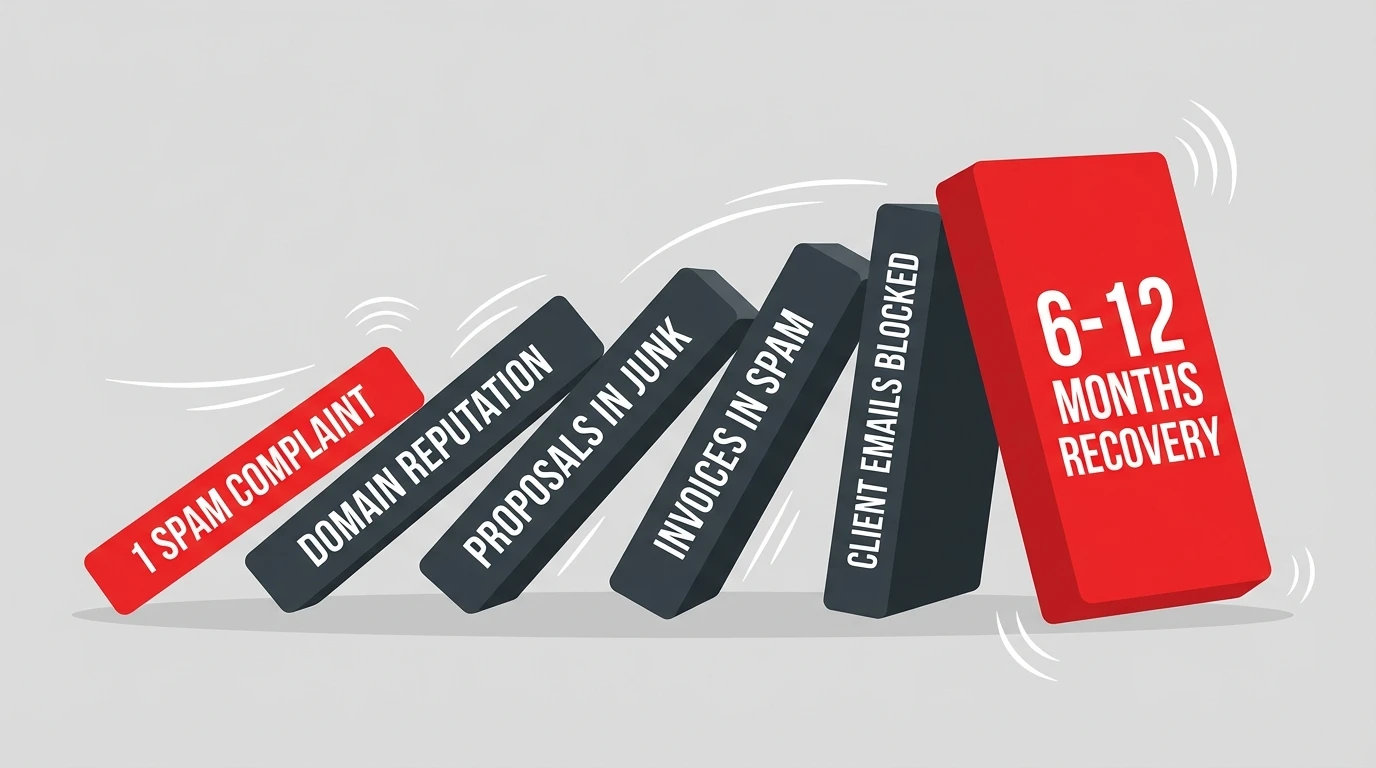
Cold calling has become associated with low-quality calls from irrelevant companies with poor offers. Generic spray-and-pray email campaigns get 0.2% conversion rates. That's spam, not strategy.
The ecosystem has shifted against lazy outbound:
- 87% of Americans don't answer calls from unknown numbers
- 80% of cold calls go to voicemail
- Gmail and Yahoo enforce a 0.3% maximum spam rate
- AI-powered spam filters evaluate engagement and content quality, not just sender reputation
- One "Spam Likely" label can crater your answer rates
Carriers evaluate calling patterns, not intentions. If your outreach looks like spam, it gets treated like spam.
But Strategic Outbound Still Works
What the anti-outbound crowd ignores:
Buyers still take meetings. 82% of B2B buyers accept meetings from strategic cold outreach. The keyword is strategic. Relevant, personalized, well-timed outreach breaks through. Spray-and-pray doesn't.
First-mover advantage is real. 35-50% of sales go to the vendor that contacts the buyer first when an opportunity arises. If you're waiting for inbound, you're often arriving after competitors have already shaped the conversation.
Deal values are higher. For smaller B2B companies (under 500 employees), outbound is the best-performing source of deals, yielding 3x larger average deal values than inbound. Proactive prospecting lets you punch above your weight and target accounts that would never find you organically.
C-suite is reachable. 57% of C-level executives prefer phone contact. The average enterprise CEO is 59 years old. While digital natives think phone calls are disruptive, the people signing big checks often don't.
The Execution Gap is Massive
The difference between average and excellent outbound:
| Approach | Reply Rate | Conversion |
|---|---|---|
| Generic spray-and-pray | 1% | 0.2% |
| Average cold email | 4-5% | 0.7% |
| Personalized outreach | 15-25% | 8-12% |
| Top-quartile campaigns | 18%+ | 15%+ |
Same channel. 10-100x difference in results.
What separates top performers:
- Personalization beyond first name: Campaigns with advanced personalization see reply rates double the average. Only 5% of senders personalize every message.
- Timing and signals: Companies that recently raised funding are 2.5x more likely to buy. Intent data updated within 7 days leads to higher engagement than stale data.
- Multi-channel sequences: Combining email, phone, LinkedIn, and voicemail yields 22% higher response rates than email alone.
- Proper infrastructure: Domain warmup, authentication (SPF, DKIM, DMARC), and inbox rotation aren't optional anymore.
The reputation problem is the 95% of outbound that's executed poorly.
Why the Best Companies Do Both
The data on integration is clear:
- Companies combining inbound and outbound see 2x revenue growth versus inbound-only
- Combined strategies increase conversions by 67%
- Marketing-sales alignment through ABM drives 27% faster revenue growth and 36% higher retention
Running both in parallel is table stakes. The real power is in the flywheel.
They Serve Different Functions
Inbound captures existing demand. When someone is already searching for solutions, already has budget, already has urgency, inbound channels intercept them. SEO, content, thought leadership: all of it positions you for discovery.
Outbound creates new demand and gives you control. 95% of your potential customers aren't actively looking at any given moment. Outbound reaches people who don't know they have a problem, or haven't prioritized solving it yet. You pick exactly who you want to talk to. You control timing. You control volume.
Two engines working in tandem. One fills the top of funnel with people who sought you out. The other proactively builds pipeline with accounts that match your ICP but haven't started their buying journey.
They Feed Each Other
The research you do for good outbound makes your inbound significantly better.
When you run outbound campaigns, you learn:
- Which pain points resonate and which fall flat
- How different segments respond to different messaging
- What objections come up repeatedly
- Which value propositions actually land
That intelligence directly feeds your content strategy. You stop writing generic thought leadership and start creating content that addresses specific objections you've heard on calls. Your LinkedIn posts get sharper because you know what language your ICP actually uses.
The feedback loop works the other direction too. Inbound content gives outbound reps ammunition. Instead of cold pitching, they can share a relevant article, reference a webinar, or cite data from your research. The outreach becomes warm because you've already established credibility.
Timing Arbitrage
Inbound is slow to build and hard to accelerate. When you need pipeline now, inbound can't help.
Outbound fills the gap. A well-executed campaign can generate meetings within days, not months. When sales is screaming for leads, when you're entering a new market, when you've got a quarter to save, outbound is how you manufacture conversations.
Then inbound compounds in the background, building the long-term engine while outbound handles the immediate pressure.
Why We Built Emitree Around This Problem
Building in the sustainability space, we saw this tension constantly. Companies selling carbon credits, ESG services, and sustainability solutions faced the same dilemma: inbound was too slow and too narrow, outbound was too manual to do well.
The bottleneck in outbound is the research. 75 minutes per prospect digging through sustainability disclosures, CDP reports, Verra retirements, LinkedIn, news. Nobody can do that at scale manually. So they skip it, send generic messages, and wonder why outbound "doesn't work."
We automated that part: company research, buyer persona selection, personalized outreach based on real sustainability signals.
But the real unlock came from watching what happened next. Every conversation becomes content fuel. The objections you hear. The language buyers actually use. The challenges they're facing. You can't get that from your desk writing LinkedIn posts.
The meetings booked through outbound gave us the insights that made our inbound 10x better. The content we created from those insights made our outbound warmer. They compound.
That's the flywheel. Outbound gives you reach and real insights. Inbound builds trust with people already looking. Together they accelerate each other.
What Makes Each Work
Outbound Success Factors
1. Targeting precision Spray-and-pray is dead. Refined prospect lists based on ICP, buying signals, tech stack, and intent data are step one. 63% of buyers engage more with personalized outreach that speaks to their industry or role.
2. Personalization depth Beyond first name. Reference their company's recent news, their specific challenges, their tech environment. Personalized subject lines alone boost open rates by 50% and conversion by 58%.
3. Multi-channel sequences Email alone isn't enough. Phone + email + LinkedIn + voicemail outperforms single-channel by 22%. Different buyers prefer different channels.
4. Infrastructure investment Domain warmup takes 45-60 days. Authentication (SPF, DKIM, DMARC) is non-negotiable. Inbox rotation and volume management prevent deliverability craters.
5. Signal-based timing Intent data that's fresh (within 7 days) dramatically outperforms stale lists. Reaching someone when they're actively researching beats reaching them randomly. 99% of businesses using intent data report higher sales or ROI.
Inbound Success Factors
1. Patience and consistency Minimum 6-9 months of sustained effort before expecting meaningful results. Content compounds, but only if you keep publishing. Most companies quit before the flywheel starts spinning.
2. Differentiation through depth 91% of B2B marketers create content. Most of it is mediocre. Original research, unique perspectives, and genuine expertise break through. The antidote to content saturation is content that couldn't exist anywhere else.
3. Personal over company On LinkedIn, personal profiles get 561% more reach than company pages. Your executives and subject matter experts posting as individuals outperform branded content significantly.
4. Format experimentation Interactive content generates 2x engagement of static content. Short-form video is where 53% of marketers are focusing. Polls have regained strength on LinkedIn with a 1.64x reach multiplier.
5. Thought leadership that earns trust Almost 60% of decision-makers have awarded business based directly on thought leadership. 47% discovered and purchased from a challenger brand through thought leadership alone.
The Real Question
The inbound vs outbound debate misses the point.
Better questions:
- Are you executing inbound well enough to break through the noise?
- Are you executing outbound well enough to avoid being marked as spam?
- Are you integrating them so they compound instead of competing?
- Do you have the data quality and infrastructure to make either work?
Companies that do both well see 2x the growth. The debate isn't which channel wins. It's whether you have the strategy, data, and execution to make either one matter.
If your inbound is stuck, you probably need outbound to generate the insights that make your content resonate.
If your outbound is dying, you probably need inbound to warm up your market and give reps something to reference.
They're not competing strategies. They're two halves of the same engine.