The Omnichannel Outreach Playbook: How to Turn Cold Outreach Warm
Estimated reading time: 9 minutes
If you were selling the best product in the world, how many follow-ups would you send before giving up?
Most salespeople say 5-7. In practice, 44% give up after one.
Meanwhile, 80% of deals require five or more touches to close.
This gap is where pipeline goes to die. But "just follow up more" isn't the answer either.
Data from 16.5 million cold emails shows reply rates drop with every send: 8.4% on the first email, 7.2% on the second, 6.8% on the third. After four emails, spam complaints triple.
More persistence doesn't work. The channel is saturated.
Cold email reply rates have dropped to 5.1%, down from 7% just a year ago. Single-channel outreach is a losing game.
The solution isn't more touches. It's more channels. And not just because the stats say so.
Why Omnichannel Works
Buyers use an average of 10 channels to interact with sellers. But here's the insight that matters: at any given stage of the buying journey, roughly one-third prefer in-person interactions, one-third want remote communications, and one-third prefer digital self-serve.
This is the Rule of Thirds. No single channel reaches everyone. Omnichannel isn't a tactic. It's table stakes.
71% of B2B buyers are now millennials and Gen Z. 65% prefer digital-first engagement. 33% want a seller-free experience entirely. They spend only 17% of their buying time meeting with potential suppliers. The rest is independent research, peer consultations, internal discussions.
You're not competing for attention. You're competing for the sliver of time they allocate to vendors.
The insight that reframed this for me: "Cold calling isn't dead. Cold calling without context is dead."
When you call someone who's seen your LinkedIn comments, received a relevant email, and viewed your profile, it's not a cold call anymore. It's a warm one.
The numbers back this up:
- Cold outreach response rates: 1-5%
- Warm outreach response rates: up to 45%
That's not a marginal improvement. That's a different game entirely.
The goal of omnichannel sequencing isn't to be everywhere. It's to make every touch warmer than the last until nothing is cold anymore.
The Framework
8-12 touchpoints over 2-4 weeks. This is the sweet spot backed by TOPO and Gartner research. Fewer touches and you're invisible. More and you're annoying. The goal is consistent presence without harassment.
Each channel warms up the next:
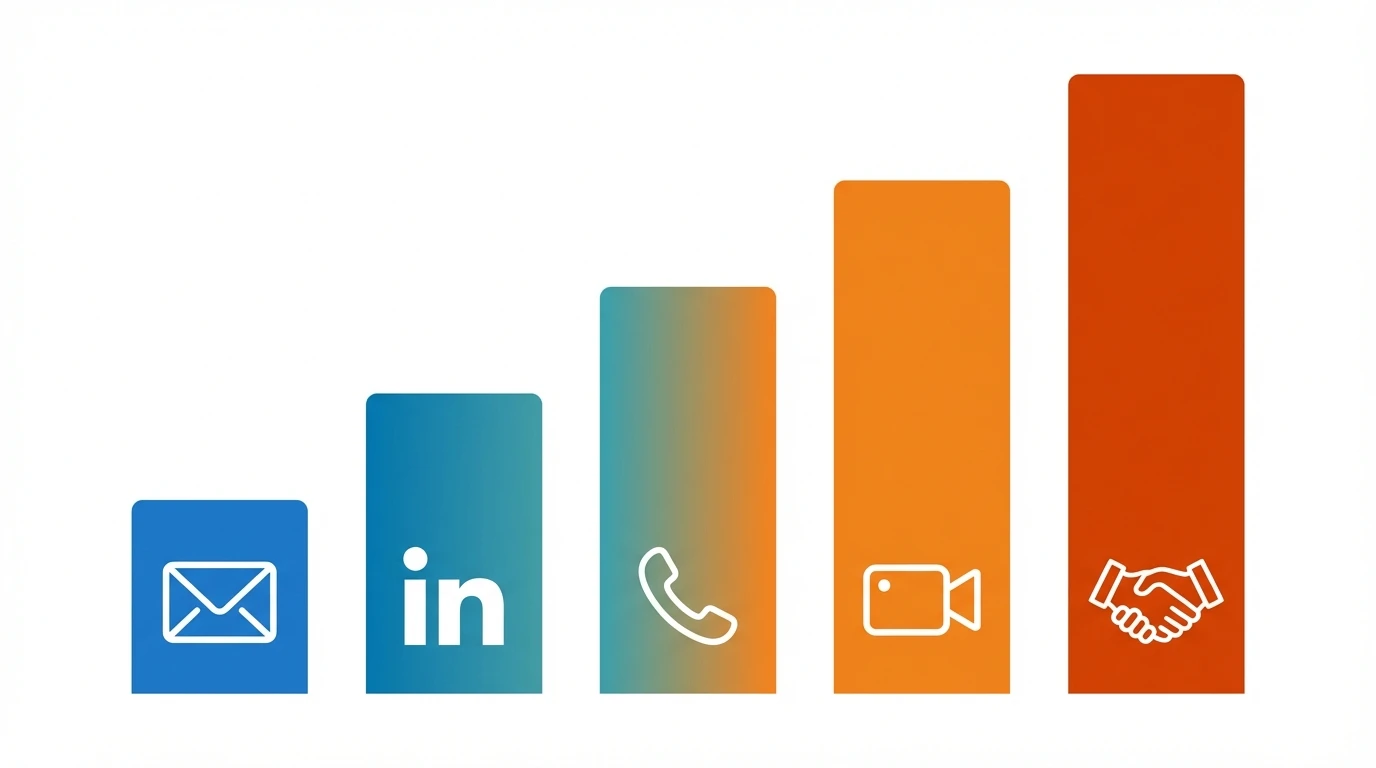
- Email establishes context. It's where you explain who you are and why you're reaching out.
- LinkedIn builds familiarity. Profile views, likes, and comments create recognition before you ask for anything.
- Phone converts awareness into conversation. By the time you call, they've seen your name. It's not an interruption. It's a continuation.
Layer them sequentially. Don't blast all channels on day one. Each touch should reference the previous one. "I sent you an email yesterday about X" creates continuity. "Hey, we've never talked but here's my pitch" creates friction.
The Sequence
A 7-touch sequence over 10 days. This structure consistently outperforms both longer sequences (fatigue) and shorter ones (insufficient presence).
| Day | Channel | Action |
|---|---|---|
| 1 | Intro email, under 100 words | |
| 2 | Connection request with personalized note | |
| 3 | Phone | Voicemail referencing your email |
| 5 | Value email: case study or relevant insight | |
| 7 | Short DM, 2-3 sentences max | |
| 9 | Phone | Follow-up call |
| 10 | Breakup email |
Why this order works:
Email first establishes context. When you reach out on LinkedIn the next day, they might recognize your name. When you call on day 3, you can say "I'm following up on an email I sent Monday." Each touch builds on the previous one.
The phone call lands mid-sequence for maximum impact. By day 3, they've had exposure. By day 9, they've seen persistent but not annoying effort. Phone calls convert awareness into conversation.
The breakup email at the end triggers loss aversion. When prospects realize the opportunity to engage is disappearing, it paradoxically makes them more willing to respond. HubSpot's enterprise team found breakup emails generate a 33% response rate.
Alternative: LinkedIn-first sequence
For high-value targets, consider warming up on LinkedIn before any outreach. Spend 10 days engaging first: profile views, likes on their posts, thoughtful comments. Then start the sequence.
One company saw LinkedIn response rates jump from 8% to 23% using this approach. That's a 3x improvement from patience.
Channel Tactics
Length matters more than you think. The optimal range is 50-125 words. Some studies suggest even shorter (20-39 words) for initial cold emails. The point: they don't know you. They won't read a novel.
Subject lines: 36-50 characters generates 32.7% more replies than shorter subject lines. Personalized subject lines lift opens by 26%. Test first names, company names, and specific pain points.
Timing: Tuesday through Thursday, 6-11 AM in the recipient's timezone. A contrarian finding: Belkins' analysis of 16.5 million B2B cold emails found that 8-11 PM sends achieved the highest reply rates at 6.52%. Evening sends work because inboxes are quieter.
The personalization minimum: Reference something specific. Their company, a recent announcement, a mutual connection, content they posted. Generic templates get generic results (deleted).
Warm up before connecting. Don't lead with a connection request. Engage first: profile views, likes on their posts, thoughtful comments.
The math on connection requests:
- Connection request only: 3.53% reply rate
- Connection request with personalized note: 9.36% reply rate
- Message plus profile visit: 11.87% reply rate
Personalized notes nearly triple your response rate. Worth the 30 seconds.
What to say in DMs: Keep it to 2-3 sentences. Reference something specific (their post, a mutual connection, a company announcement). Ask one simple question. Don't pitch.
Phone
97% of cold calls go to voicemail. Plan accordingly. Your voicemail is your real deliverable.
Voicemail sweet spot: 18-30 seconds. Shorter works too (8-14 seconds for busy executives). State your name, company, why you're calling, and when you'll try again. No rambling.
The power move: Voicemail plus email on the same day generates 40% higher response rates than standalone emails. Leave the voicemail, then immediately send a short email saying "Just left you a voicemail about X. Quick question..." The double touch creates urgency.
Best times to call: Tuesday through Thursday, 10 AM to 4 PM. Mondays are catch-up days. Fridays are wind-down days. Mid-week, mid-day is when people are in work mode.
Video (Optional High-Impact Touch)
Video emails generate 26% higher reply rates and 4x higher click-through rates than text-only emails.
Keep videos short: 30-60 seconds max. Personalize with the prospect's name in the thumbnail. Reference something specific about them or their company.
Consider adding a video touch on Day 5 instead of (or in addition to) the value email. It stands out in a sea of text. Tools like Vidyard and Loom make this easy.
Speed to Lead: The Timing Multiplier
All the sequencing in the world doesn't matter if you're slow on inbound.
The data:
- A lead is 9x more likely to convert when contacted within 5 minutes of an inquiry
- Response rates are 450% higher when follow-up happens within one hour
For inbound leads, demo requests, or trigger events (job changes, funding announcements, intent signals), speed beats sequence. Have a process that gets a human response out within minutes, not hours.
The sequence framework above is for outbound prospecting. Inbound requires a different gear entirely.
Multi-Threading: The Overlooked Multiplier
Most sequences target one person. But buying committees now average 6-10 stakeholders. Enterprise deals can involve 20+.
The impact of engaging multiple contacts:
- Single-threaded deals (one contact): 5% win rate
- Five stakeholders engaged: 30% win rate
That's a 6x improvement from expanding your footprint within the account.
Who to map:
- Decision-makers (CEO, CFO, CTO, Department Heads)
- Influencers (Managers, Senior Engineers, SMEs who shape opinions)
- End users (people who'll use the product daily)
- Champions (internal advocates who want you to win)
- Blockers (Legal, IT, Finance who can slow or kill deals)
The risk of single-threading: 80%+ of sellers say deals have stalled because a key stakeholder left the company. Multi-threading is insurance against champion departure.
Run parallel sequences to 3-5 contacts per account. Coordinate messaging so it doesn't feel like spam. Reference conversations with their colleagues ("I've been speaking with Sarah on your team about X").
Scaling Without Losing Quality
You can't give every prospect the same attention. Tiering solves this.
| Tier | Accounts | Approach |
|---|---|---|
| Tier 1 | 10s | High-touch: personalized research, custom messaging, executive outreach, 15-20 touches |
| Tier 2 | 100s | Hybrid: automation with personalization layers, 10-15 touches |
| Tier 3 | 1,000s | Automated: template-based with basic personalization, 5-8 touches |
The allocation rule: Spend 50% of your outbound hours on Tier 1 accounts. These are your best-fit prospects with the highest deal potential. They deserve research, customization, and human attention.
Tier 3 is efficient. Automation handles the volume while you focus energy where it counts.
The AI-SDR hybrid: 45% of sales teams now use hybrid AI-SDR models. These achieve 4-7x higher conversion rates than manual-only approaches and reduce research time by 90%. AI handles data gathering and initial personalization. Humans handle judgment calls and relationship building.
No-Show Protocol
Meetings booked don't equal meetings held. No-shows are pipeline leakage.
Prevention: Automated reminders reduce no-shows significantly. 88% of teams using calendar reminders see improvement.
Reminder cadence:
- 24 hours before: "Looking forward to our conversation tomorrow"
- 4 hours before: Day-of reminder with reschedule option
When they don't show up:
| Time After Start | Action |
|---|---|
| 3 minutes | Email: "Having trouble logging on?" |
| 5 minutes | Call their mobile |
| 15 minutes | Email again, CC the SDR who booked it, include reschedule link |
| Next day | SDR follow-up to reschedule |
The rule: Give prospects 15 minutes before logging out. They might be running late. But don't wait longer. Your time has value too.
Re-Engaging Dormant Leads
Up to 79% of marketing leads never convert. Most become stagnant in the CRM, never touched again.
This is waste. Dormant leads already know you. They're warmer than cold prospects.
Re-engagement effectiveness:
- 45% of recipients read re-engagement messages
- 75% of re-engaged customers continue opening subsequent emails
- One campaign showed 10% higher conversion from dormant leads vs. new leads
Sample re-engagement sequence for 90-day inactive leads:
| Day | Action |
|---|---|
| 1 | Low-commitment offer: research report, guide, industry data |
| 5 | Related case study (if engaged) or different angle (if not) |
| 12 | Webinar invite (if engaged) or move to long-term nurture (if not) |
Don't treat cold and dormant the same. Dormant leads have history with you. Reference it.
What Kills Sequences
These mistakes destroy outbound performance:
Starting with a meeting request. They don't know you. Why would they give you 30 minutes? Provide value first. Build relationship. Earn the ask.
Massive pitch in first email. Long emails from strangers get deleted. Save the detail for when they're interested.
Wrong frequency. Too aggressive (daily emails) feels like spam. Too infrequent (monthly) loses momentum. The 2-4 week sequence with 8-12 touches exists because it works.
No personalization. Generic templates get treated like spam because they are. Reference something specific or don't bother.
Giving up after one follow-up. 44% of salespeople do this. Meanwhile, 80% of sales require five or more touches. Persistence beats talent when talent doesn't persist.
Single-threading. Putting all your chips on one contact in a 10-person buying committee is a gamble. Spread your footprint.
Never testing or iterating. What worked six months ago may not work today. Reply rates change. Best practices evolve. Test subject lines, email length, send times, channel order. Sequences that don't evolve become sequences that don't work.
Start Here
You don't need to overhaul everything at once.
Week 1: Pick your best ICP segment. Build one sequence following the 7-touch structure above. Run it against 20-30 prospects.
Week 2: Track opens, replies, and meetings booked. Identify which touches are working and which are falling flat.
Week 3: Iterate. Adjust the underperforming elements. Test one variable at a time so you know what's driving improvement.
Ongoing: Once the sequence works, tier your accounts. Automate Tier 3. Personalize Tier 1. Add multi-threading for your highest-value targets.
The goal isn't to follow this playbook exactly. It's to build a system where every channel warms up the next, until nothing you do is truly cold.
Start with one sequence. Get the reps. The compounding starts there.