The Best Time to Send Cold Outreach: What 300 Million Calls and 16.5 Million Emails Actually Show
Estimated reading time: 9 minutes
What the data actually says about when to send, and why knowing it still isn't enough.
Tuesday morning. 10 AM. Prospect's local time.
That's the conventional wisdom. Ask any sales trainer, read any outreach guide, and you'll hear some version of this advice.
The research backs it up. Sort of.
We went through the major studies: 1.4 million cold calls analyzed by ZoomInfo, 300 million calls studied by Gong, 16.5 million cold emails examined across multiple research teams, and 2.7 billion LinkedIn engagements tracked by Sprout Social. We didn't run these experiments ourselves, but the patterns across hundreds of millions of touches are consistent enough to act on.
The problem is execution. You know Tuesday 10 AM is the window. You know evening emails outperform afternoon sends. You've bookmarked every study.
Then you finish writing an email at 3 PM and hit send because you're done. You mean to follow up on day 3 and realize on day 12 you forgot. Your prospect is in Singapore and optimal send time is 2 AM your time.
Knowing the optimal time is useless if you can't execute on it. This guide covers what the research shows, channel by channel, and what to do about the execution gap.
What the Email Data Shows (2026)
Best Days to Send Cold Emails
Consistent across every study we reviewed.
| Day | Performance | Notes |
|---|---|---|
| Tuesday | Highest open and reply rates | Best overall for B2B |
| Wednesday | Close second on response rates | Strong performer |
| Thursday | 44% open rate in morning window (Zeliq) | Mornings especially effective |
| Monday | Catch-up mode | Prospects clearing weekend backlog |
| Friday | Lowest on most metrics | Wind-down mode |
| Weekend | Avoid | Significantly lower engagement |
Midweek wins. Monday is recovery, Friday is wind-down. Tuesday through Thursday captures people when they're in work mode but not overwhelmed.
Best Times to Send Cold Emails
| Time Window | Performance | Why It Works |
|---|---|---|
| 9-11 AM | Peak open rates | Prospects checking email after morning meetings |
| 1-2 PM | Secondary peak | Post-lunch email check |
| 6-8 AM | Works for C-suite | Executives clear inbox before day starts |
| 8-11 PM | 6.52% reply rate | Quiet inbox, fewer distractions |
That evening window catches people off guard. Analysis of 16.5 million B2B cold emails found that messages sent between 8-11 PM achieved a 6.52% reply rate, beating traditional business hours. Executives check email in the evening with fewer competing messages. Your email doesn't get buried under 50 others that all arrived at "optimal time."
Yesware found that 75% of all cold emails are opened within 1 hour of sending, and 95% of replies come within 24 hours. So timing isn't just about the day and hour. It's about landing in the inbox at the moment your prospect is actively checking.
Persona-Specific Timing
Generic "best time" advice doesn't account for how your specific buyer works. A sustainability director's schedule looks different from a sales VP's.
| Persona | Best Windows | Rationale |
|---|---|---|
| C-suite executives | 6-8 AM or after 6 PM | They're in meetings all day |
| VP/Director level | 10:15-11:45 AM or 2-3:30 PM | Between their meetings |
| Ops/Finance/IT | 8:30-9:30 AM or 1:30-3:30 PM | Desk-bound, consistent schedules |
| Healthcare professionals | 5:30-7 AM, 12-1 PM, 9-11 PM | Off-hours due to patient care |
| Financial services | 10 AM-12 PM Wed-Thu | Avoid active market hours |
What the Phone Data Shows
Cold calling has its own timing dynamics, and some of the conventional wisdom is flat wrong.
Best Days for Cold Calls
ZoomInfo analyzed 1.4 million outbound calls:
| Day | Performance | Key Metrics |
|---|---|---|
| Tuesday | Best overall | Highest connect rates, tied for highest positive call rate (4.8%) |
| Wednesday | Second best | Highest call volume, 44% of total demos (with Tuesday) |
| Thursday | Distant third | Metrics decline notably |
| Monday | Surprisingly efficient | Highest call-to-demo rate (1.19%) |
| Friday | Worst on every metric | Lowest volume, connects, demos, positive rates |
Tuesday and Wednesday dominate. Friday is a waste of dial time.
Best Times to Make Cold Calls
| Time | Performance | Source |
|---|---|---|
| 10-11 AM | 31% higher connect rates than average | Cognism, HubSpot |
| 4-5 PM | 71% more conversions than second-best slot | Revenue.io |
| 2-3 PM | Strong secondary window | Gong (longest call durations) |
The afternoon finding surprises people. "Never call after 4 PM" is common advice. Revenue.io's data says the opposite: decision-makers have wrapped up their meetings by late afternoon. They're at their desk, winding down, and more receptive to unexpected calls. They pick up.
Avoid 7-9 AM (people rushing to start), noon (lunch), and after 5 PM (commute). Call duration data confirms it: calls during those windows are the shortest on average.
The Connection Rate Reality
| Performance Level | Connect Rate | Calls to Connect | Meeting Booking Rate | Meetings/Month |
|---|---|---|---|---|
| Average rep | 5.4% | 19 dials | 4.6% | 2 |
| Top quartile rep | 13.3% | 8 dials | 16.7% | 18 |
Same prospects, same phones. Top performers book 9x more meetings per month. Timing, targeting, and technique account for most of that gap.
What the LinkedIn Data Shows
LinkedIn engagement follows the "break" schedule. People check it between meetings, at lunch, and at end of day. Not during deep work.
Best Days and Times
Sprout Social analyzed 2.7 billion engagements across 436,000 profiles:
| Day | Performance |
|---|---|
| Tuesday | Strong, especially 8 AM-2 PM |
| Wednesday | Peak engagement, 8 AM and noon |
| Thursday | Strong, 8 AM and noon |
| Friday | Drops after midday |
| Saturday | 8% below average response rate |
Best messaging windows: 9-11 AM (morning routine), 1-2 PM (post-lunch), and 4-5 PM (wind-down).
Industry-Specific LinkedIn Timing
| Industry | Best Times | Peak Days |
|---|---|---|
| Financial Services | 10 AM-1 PM | Wed-Thu |
| Healthcare | 10 AM-4 PM | Tue-Thu |
| Technology/Startups | 6:30-8 AM or 8-10 PM | Flexible |
| Nonprofit | 9 AM-1 PM | Tue-Wed |
Tech and startup people have unpredictable schedules. You might catch them early morning or late evening. Traditional industries stick to business hours.
One stat from LinkedIn's own InMail research: messages under 400 characters get 22% better response rates. The shortest messages outperformed the longest by 41%. LinkedIn isn't email. Brevity wins.
The Voicemail Strategy Most Reps Get Wrong
Most reps either skip voicemails entirely or leave too many. Gong studied 300 million calls and the data is clear:
| Metric | Without Voicemail | With 1-2 Voicemails | With 3+ Voicemails |
|---|---|---|---|
| Email reply rate | 2.73% | 5.87% | 2.2% |
| Future connect rate | 7.18% | 5.17% | Lower |
Voicemails don't generate callbacks. They prime email responses. Leaving a voicemail more than doubles your email reply rate. But after 3 voicemails, reply rates drop below what you'd get with no voicemail at all. You've crossed from persistent to annoying.
The "Double Tap" rule:
- Leave exactly 2 voicemails maximum
- First voicemail: 15 seconds, context only, no pitch
- Second voicemail: 30 seconds, context plus social proof
- Then stop calling and focus on other channels
Best times to leave voicemails: 10-11:30 AM (18% above average callback rate) and 4-5:30 PM (15% above average). Late afternoon works because people listen to voicemails as they're leaving.
The Multi-Channel Timing Advantage
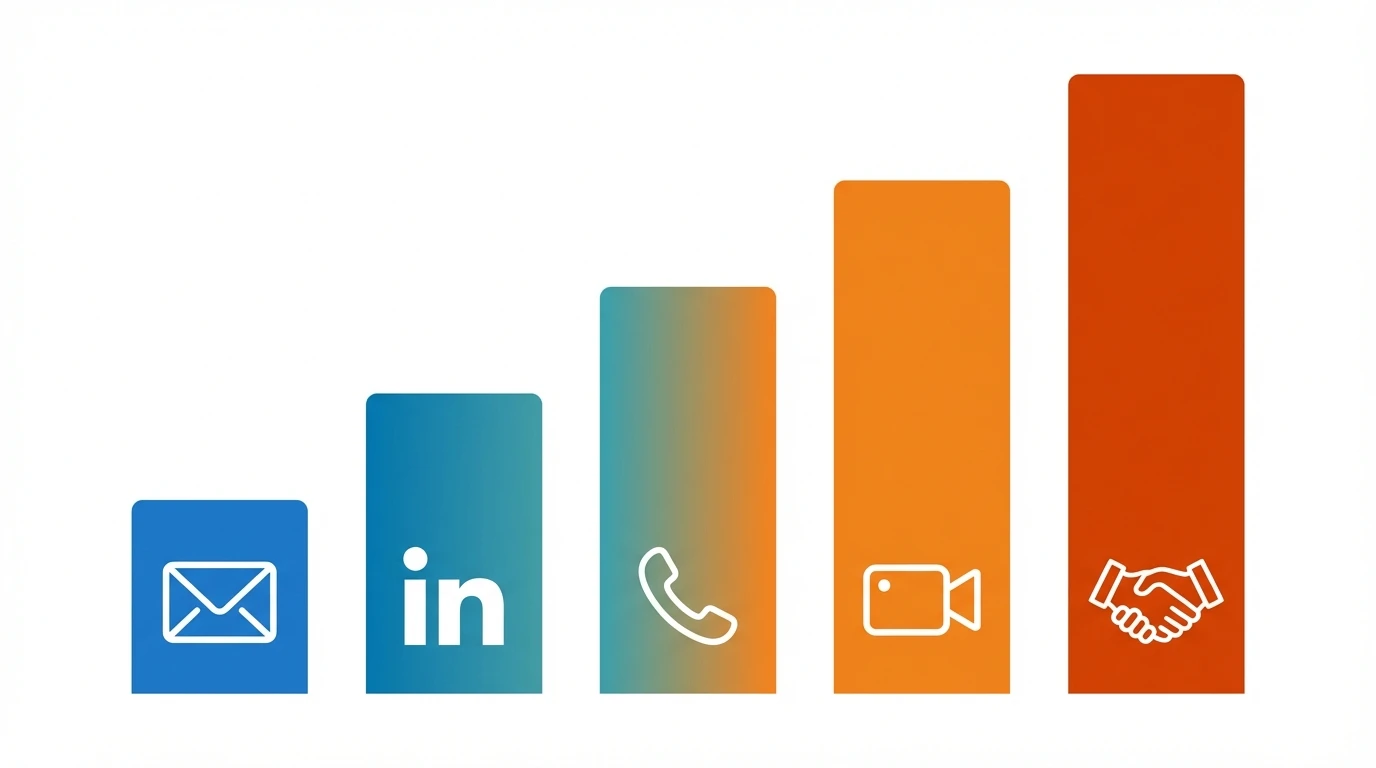
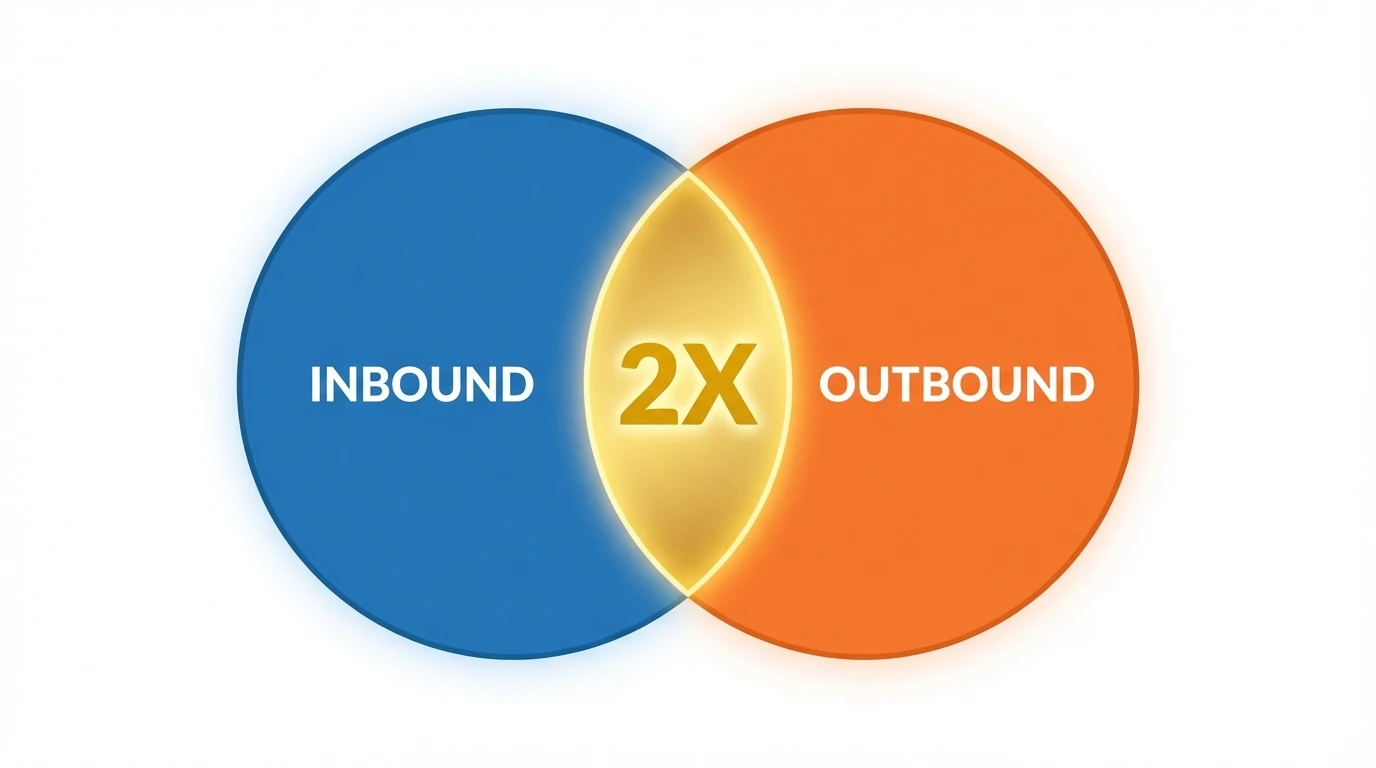
Using 3+ channels doubles engagement rates and lifts reply likelihood by over 50% (Cognism, Woodpecker, and Leads at Scale all converge on this). Email alone gets baseline results. Email plus phone plus LinkedIn gets 2x.
A Sample 10-Day Sequence
| Day | Channel | Action | Timing |
|---|---|---|---|
| 1 | Introductory email | 9-10 AM prospect's time | |
| 1 | Connection request (blank) | Midday | |
| 1 | Phone | Call attempt | 4-5 PM prospect's time |
| 3 | Phone | Call + voicemail #1 (15 sec) | 10-11 AM |
| 5 | Value-focused follow-up | 9-10 AM | |
| 7 | Direct message | 9-11 AM | |
| 7 | Phone | Call + voicemail #2 (30 sec) | 4-5 PM |
| 9 | Phone | Final call attempt | 10-11 AM |
| 10 | Break-up email | 9 AM |
The "Power of Three" technique: On day 1, hit the prospect with three different touches in quick succession. Morning email, midday LinkedIn, afternoon call. This creates pattern interruption and builds familiarity fast.
Follow-Up Timing
First follow-up after 2-3 business days. Second follow-up 4-5 days later. Third and beyond, 5-7 days each. For C-level targets, space all touches 5-7 days apart. Most replies come within 2 days, so if you haven't heard back in 3, following up is fair game.
Follow-Up Discipline Beats Timing
Cognism's cadence research:
48% of sales reps never send a second message.
80% of sales require 5 or more touches.
Half of all reps give up after one attempt. Four out of five sales need at least five. If you're one-and-done, you're leaving most of your potential pipeline on the table.
The Breakup Email Effect
The "breakup email" is the final message in a sequence that signals you're about to stop reaching out. Multiple sales teams report it consistently outperforms every other email in the sequence. Loss aversion kicks in when people realize the option is about to disappear.
Most reps never send it because they give up at message 2 or 3. The breakup email requires getting to message 5, 6, or 7 first.
Why We Built Emitree to Handle This
Timing optimization requires either superhuman discipline or automation. Most sales teams have the research. Very few can execute on it consistently across timezones, channels, and follow-up cadences while doing the rest of their job.
That's why we built automated outreach into Emitree. Sends scheduled for 9 AM in each prospect's timezone. Follow-ups triggered on day 2, 5, 10. Voicemails capped at 2. Multi-channel sequences that run while your team focuses on the conversations that actually close deals.
Quick Reference: The Optimal Timing Cheat Sheet
| Metric | Optimal |
|---|---|
| Best days | Tuesday, Wednesday, Thursday |
| Best time | 9-11 AM recipient's local time |
| Secondary time | 8-11 PM (contrarian but effective) |
| C-suite timing | 6-8 AM or after 6 PM |
| First follow-up | 2-3 business days |
| Max follow-ups | 4-9 (after 9, diminishing returns) |
Phone
| Metric | Optimal |
|---|---|
| Best days | Tuesday, Wednesday |
| Best morning time | 10-11 AM |
| Best afternoon time | 4-5 PM |
| Worst day | Friday |
| Avoid | 7-9 AM, 12 PM, after 5 PM |
| Metric | Optimal |
|---|---|
| Best days | Tuesday, Wednesday, Thursday |
| Best times | 9-11 AM, 1-2 PM |
| Message length | Under 400 characters |
| Worst day | Saturday (8% below average) |
Voicemail
| Metric | Optimal |
|---|---|
| Max voicemails | 2 |
| First voicemail | 15 seconds, context only |
| Second voicemail | 30 seconds, context + social proof |
| Best times | 10-11:30 AM, 4-5:30 PM |
Sources
Phone timing & connection rates:
- ZoomInfo: Best Days to Cold Call (1.4M calls)
- Revenue.io: Top Cold Calling Times
- Cognism: Cold Calling Statistics 2026
Voicemail effectiveness:
Email timing & reply rates:
- Zeliq: Best Days for Email Open Rates
- Smartlead: Cold Email Stats 2025
- Superhuman: Email Response Time Statistics
LinkedIn timing & engagement:
Multi-channel cadence & follow-up: