Your conference booth costs $50K. Most of that money is wasted.
Estimated reading time: 7 minutes
A mid-size company sending four people to a major industry conference spends $47,000 to $91,000. That covers the booth, the build-out, shipping, flights, hotels, meals, and the staff time nobody accounts for. CEIR data shows trade shows eat 31.6% of total B2B marketing budgets, the single largest line item most companies carry.
And yet: 44% of exhibitors don't set specific objectives before attending. Only 6% feel confident they can actually convert the leads they collect. Only 35% bother tracking whether trade show leads turn into revenue.
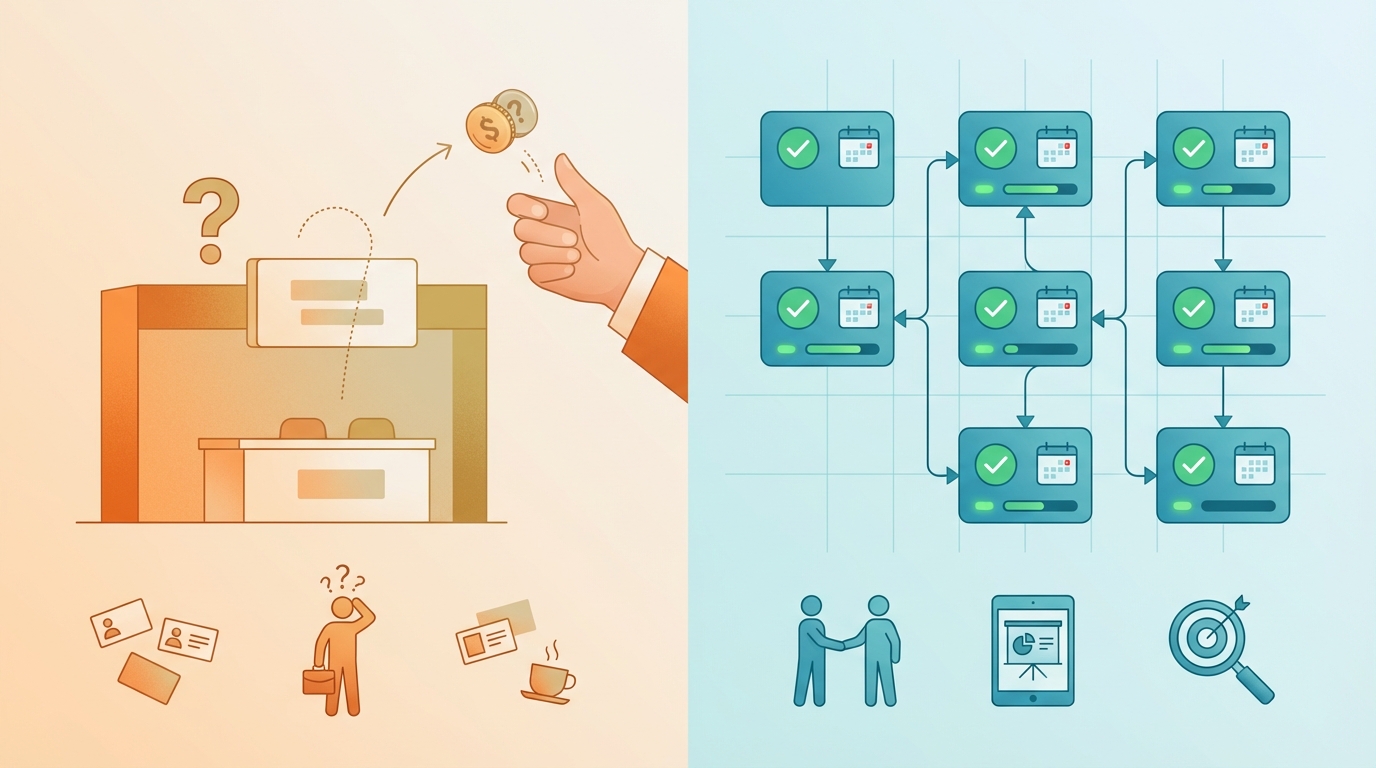
That's not a marketing channel. That's a coin flip with five-figure stakes.
The strange part is that conferences work. 52% of business leaders say trade shows deliver the greatest ROI of any marketing channel. The event isn't the problem. Most teams just treat attendance as the strategy. Show up, set up the booth, scan some badges, hope the right people walk by.
Hope is not a conference strategy.
Before choosing a room, compare the sustainability conference focuses. The carbon-market, renewable-energy, water and data-center selections distinguish different audiences and access conditions. Use the relevant focus to narrow your event shortlist before preparing account research.
The room is full of buyers you can't find
The waste stings because the audience is stacked with decision-makers.
CEIR's data on trade show attendees is striking. 81-84% have purchasing authority. 46% hold senior management positions. 46% are in the final buying decision stage at the time of the event. 77% of executives say they use trade shows specifically to identify new suppliers.
These aren't tire-kickers. These are people actively looking to buy.
But at a conference with 3,000 attendees, your actual ICP match might be 150-300 people. You have two and a half days to find them among the other 2,700. And 75% of attendees already know which booths they're visiting before the doors open. If you haven't earned a spot on that shortlist, you're invisible.
67% of trade show attendees represent completely new prospects for the exhibiting company. 90% haven't met the exhibitor face-to-face in the prior 12 months. The upside is massive. But it only materializes if you know who to talk to and they know you're worth talking to.
The prep bottleneck nobody budgets for
Conference preparation for a B2B sales team follows a predictable spiral.
Get the attendee list, if the organizer shares it. Often it arrives days before the event, sometimes gated behind a $5,000-$20,000 sponsorship tier. Filter by ICP: title, company size, industry, geography. Cross-reference against the CRM for existing accounts and open pipeline. Then comes the part that kills the whole process: individual prospect research.
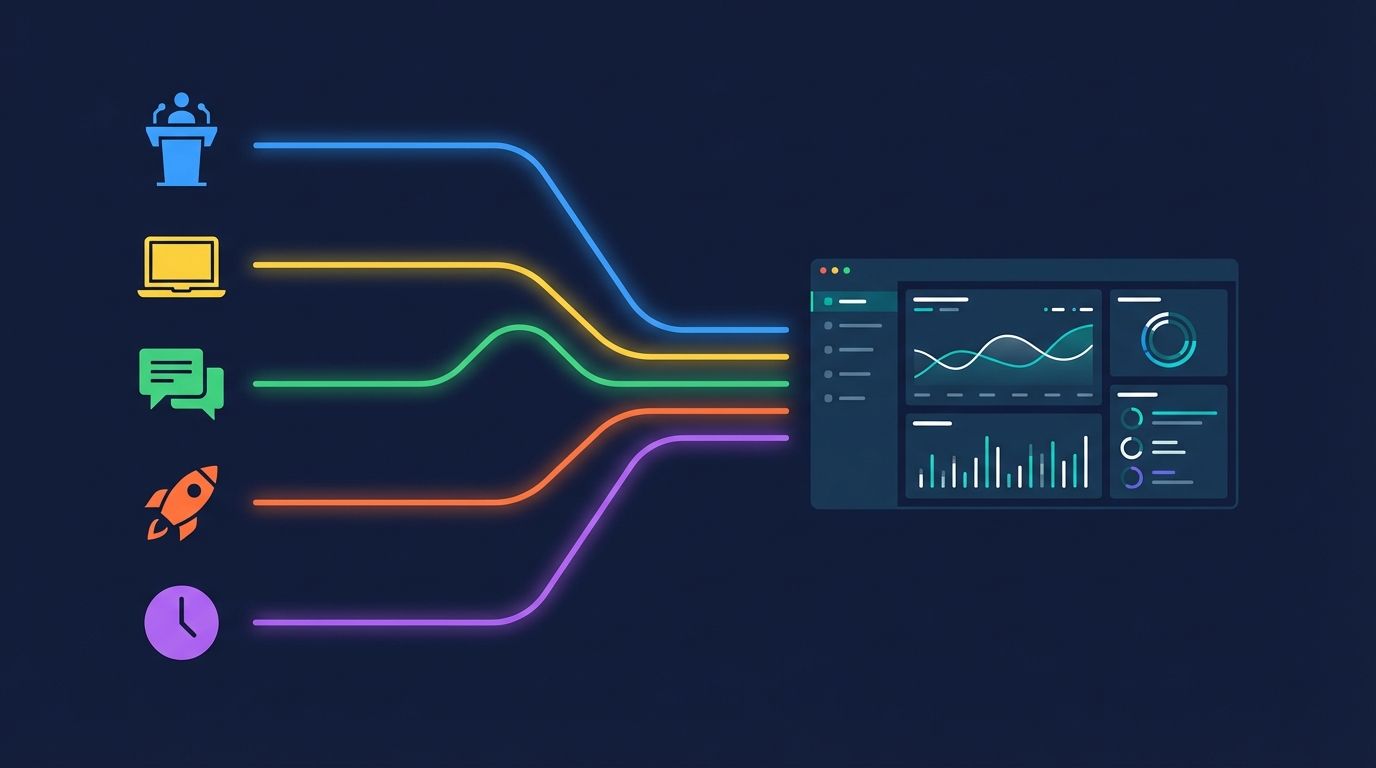
Thorough research takes 30-90 minutes per account. You're toggling between LinkedIn, the company website, news articles, your CRM, and whatever industry databases matter for your vertical. For sustainability sellers, add ESG disclosures, SBTi commitment databases, CDP reports, Verra and Gold Standard retirement records. Five to seven tools, sequentially, for every single prospect.
| Step | Tools | Time per prospect |
|---|---|---|
| Attendee list filtering | Conference app, spreadsheet | 2-5 min |
| CRM cross-reference | Salesforce/HubSpot | 3-5 min |
| Company research | Website, LinkedIn, news, Crunchbase | 10-20 min |
| Industry-specific signals | ESG databases, regulatory filings, project registries | 10-25 min |
| Contact enrichment | Apollo, ZoomInfo, Sales Navigator | 5-10 min |
| Outreach draft | Email, LinkedIn | 5-10 min |
| Total | 5-7 tools | 35-75 min |
At 30 prioritized prospects, that's 17 to 37 hours of research. Crammed into the two weeks before the event. While the team is also doing their regular job.
Most teams don't do this. They send a generic email blast ("Visit us at Booth 412!"), print some brochures, and fly out on Monday morning. The research doesn't happen because the research can't happen at that volume with manual tools.
Pre-conference outreach changes the math
The data on pre-show outreach is unambiguous.
Pre-booked meetings convert to opportunities at 3-4x the rate of walk-up booth traffic. Personalized, targeted outreach to qualified attendees converts at 15-25%, compared to 2-4% for generic emails. No-show rates for pre-booked meetings run 15-20%, versus 35-40% for loosely scheduled or spontaneous meetings.
Exhibitors who run pre-show campaigns see 50-75% more qualified traffic at their booth (CEIR). A Deloitte study found that pre-show promotions improve the quality of booth audiences by 46%.
The math is simple. Take that same $50,000 conference investment. With no preparation, you're relying on foot traffic and chance encounters. Maybe 5-10 real conversations over two days.
With 15 pre-booked meetings, plus 10 quality floor conversations, you leave with 25 qualified leads. Same investment. Radically different return.
The meetings themselves are better too. When a prospect commits to a calendar slot, they've pre-qualified themselves. They know your name and what you do. The conversation starts at "how does this apply to us" instead of "so what does your company do?"
What happens after the handshake
The follow-up gap might be worse than the preparation gap.
Up to 80% of trade show leads are never followed up on. The stat has circulated long enough that the original source is debated, but CEIR and Salesforce have both pointed to similar figures. Even conservative estimates put it at 50%.
40% of exhibitors wait three to five days before contacting prospects. By then, the lead is cold. Harvard Business Review's speed-to-lead research shows that firms contacting leads within one hour are 7x more likely to qualify them. Wait 24 hours and your odds drop 60x.
This is where the second half of conference ROI lives.
Not every qualified attendee can meet during the event. Schedules conflict. Booths get crowded. People leave early. The attendees you couldn't reach at the conference are still warm prospects, but only if you reach them while the event is fresh.
Post-conference outreach with context: what sessions they attended, what their company is working on, why you're reaching out specifically. That's the difference between a warm introduction and another cold email landing in a flooded inbox the Monday after the show.
Turn conference attendance into a pipeline engine
We built this capability into Emitree because we watched sustainability sales teams go through the same painful cycle. Spend $30,000 on a conference. Scramble to prep the week before. Come home with a stack of business cards and no follow-up plan. Three months later, nobody can point to a single deal that came from the event.
Emitree qualifies conference attendees against sustainability-specific signals: Verra and Gold Standard project retirements, ESG disclosure patterns, CDP reporting status, SBTi commitments, active procurement signals. The system identifies which attendees are actually in buying mode, not just which ones have the right title.
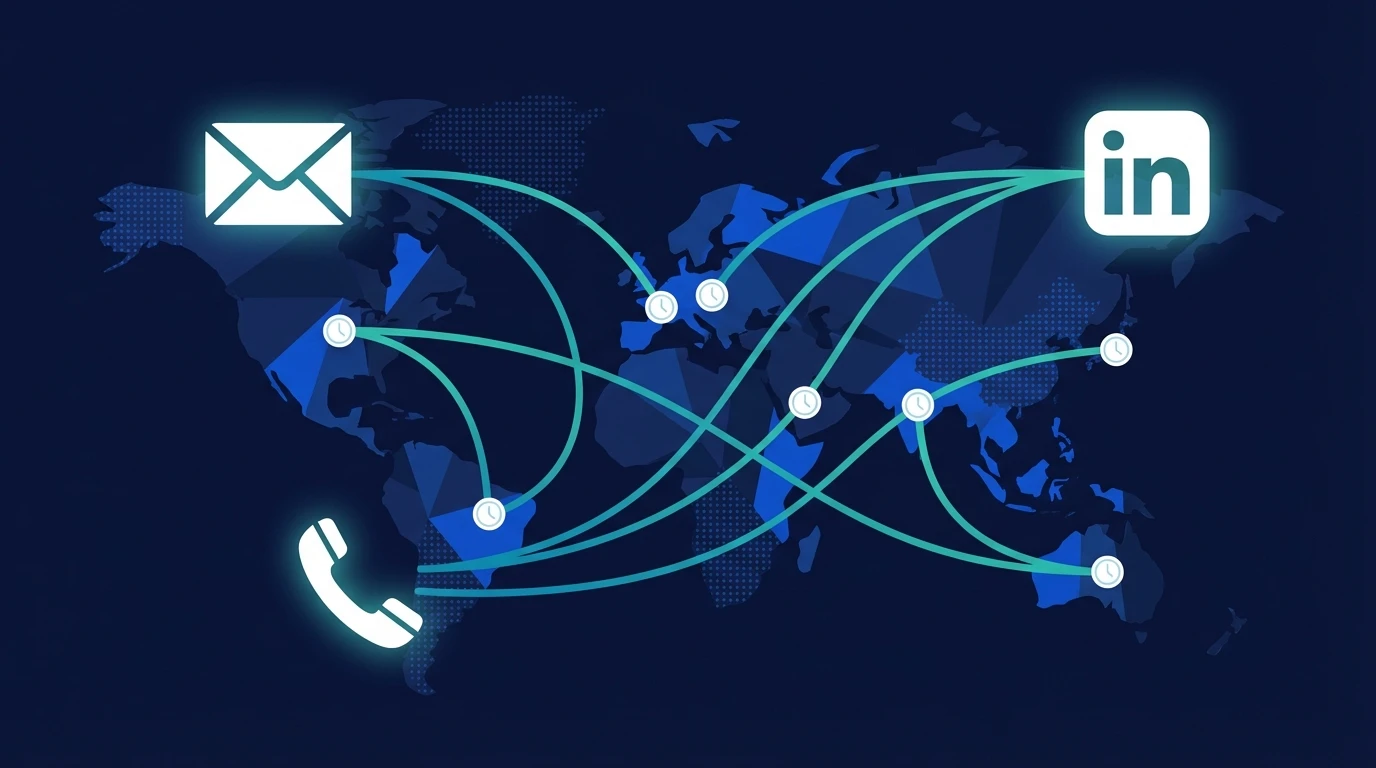
Then it runs soft-touch, personalized pre-conference outreach to book meetings. Not "visit us at Booth 412." Outreach that references what their company is doing in sustainability and why a conversation makes sense right now.
For attendees who can't meet at the event, Emitree runs post-conference sequences while the context is still warm. The research that would take 30-75 hours manually happens before the attendee list goes stale. At a fraction of the cost of the conference attendance itself. See how our conference outreach works.
Luck favors the prepared
The U.S. trade show market hit $15.8 billion in 2024 and it's growing. Companies are spending more per event, attending more events, sending bigger teams. The average company spent $1.37 million on trade shows in 2023, up from $805,000 the year before.
The investment is going up. The preparation hasn't kept pace. Most exhibitors are spending more money on the same passive approach: better booths, nicer swag, bigger teams standing around waiting for traffic.
The gap between prepared and unprepared exhibitors is widening. The companies doing the research, booking the meetings, and running the follow-up are pulling further ahead. Everyone else is subsidizing the event for them.
Conferences aren't broken. The way most companies work them is.
Picking the right event is half the battle. Our sustainability and carbon conferences directory lists every event that matters this quarter and next, with verified prices, audience breakdowns, and a straight go-or-skip call for each.
We built Emitree to close the gap between conference investment and conference return for sustainability sales teams. If you're spending $30K+ per event and can't point to the pipeline it generated, that's the problem we solve.
Sources
- CEIR via Cvent - 47 Trade Show Statistics — Attendee purchasing authority (81-84%), new prospect rates (67%), pre-show planning behavior
- Trade Show Labs - 150+ Trade Show Statistics for 2026 — Exhibitor objective-setting gaps, lead conversion confidence, cost benchmarks
- Lensmor - Event Intelligence for Trade Show ROI — Pre-booked meeting conversion rates (3-4x), outreach conversion (15-25% vs 2-4%)
- Freeman 2024 Exhibitor Trends Report — Trade show budget share (31.6%), exhibitor priorities
- CEIR via Trade Show Executive - Exhibitor Success Report — Pre-show campaign effectiveness (50-75% qualified traffic lift)
- Schwab IMPACT 2026 Exhibitor Pricing — Named conference cost examples ($16,500 - $180,000)
- Salesmotion - From 6 Hours of Research to 6 Minutes — Manual vs. AI-assisted research time benchmarks
- Wave Connect - Trade Show Statistics 2025 — Industry scale ($15.78B market), global exhibition impact
- Conference Source - Trade Show Statistics — Follow-up failure rates, attendee purchase intent