Cold outbound is one motion. The teams winning deals are running five.
Estimated reading time: 8 minutes
Cold outbound reply rates dropped from 7% to 3.4% in three years. That's Belkins' data across 16.5 million emails. Not a blip. A structural decline.
The natural response: pivot to "warm outbound." Better signals, better timing, better personalization. It works. Signal-based outreach pulls 15-25% reply rates versus 1-5% for generic cold (MarketBetter). SDR quota attainment jumps from 52% to 78%.
But warm outbound is still one motion.
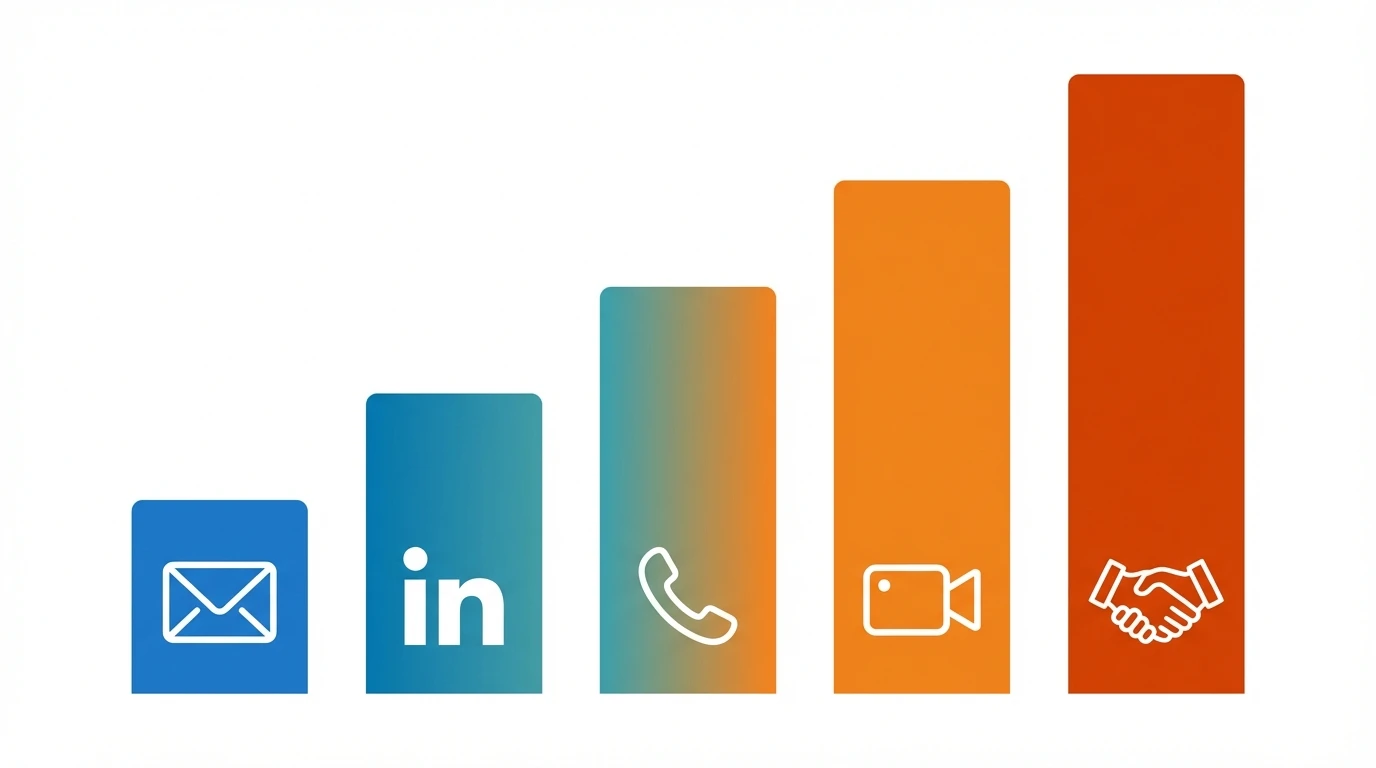
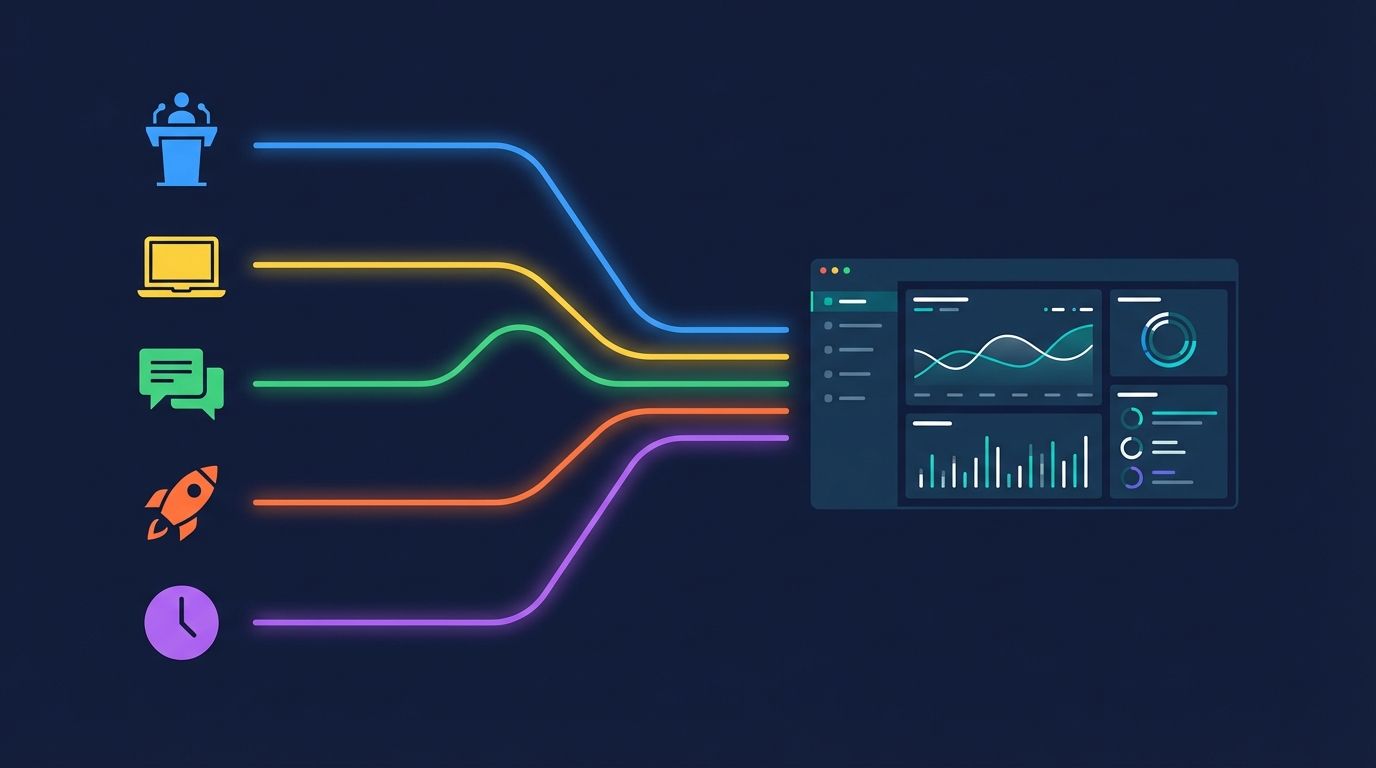
The teams pulling ahead aren't running one warmer version of cold email. They're launching conference follow-up sequences the same week as a product launch campaign, while re-engaging dormant leads and nurturing webinar attendees. Five motions in parallel. Different timing, different messaging, different channel logic for each.
That's where everything breaks.
Five motions, five completely different playbooks
A conference follow-up and a cold outbound sequence have almost nothing in common. Treating them the same way is how most teams waste both.
| Motion | Timing window | Key context | Primary channel | Failure mode |
|---|---|---|---|---|
| Cold outbound | Rolling, weeks-long cadence | Firmographic + intent signals | Relevance: message doesn't connect | |
| Conference follow-up | 24-48 hours | Booth conversations, sessions attended | Email + LinkedIn | Speed: 80% of leads never get followed up |
| Webinar follow-up | 72 hours | Engagement depth, questions asked | Segmentation: one-size drip kills conversion | |
| Product launch | Time-bound burst, 2-4 weeks | Feature relevance to prospect's pain | Multichannel | Coordination: marketing and sales misaligned |
| Dormant reactivation | Triggered by signal change | Full relationship history, reason they went quiet | Email + phone | Context: generic "checking in" gets ignored |
The numbers behind each motion are worth sitting with.
Conference leads followed up within 48 hours are 60% more likely to convert (SalesHive). Yet 80% of trade show leads never get followed up at all. 81% of those attendees have purchasing authority (Cvent). Think about that: you spent $15,000 on a booth to meet buyers who are ready to buy, then four out of five walked away without hearing from you again.
Webinar leads have a 72-hour half-life. After three days, 73% go cold (MarketingProfs). A webinar attendee who watched the full session, asked two questions, and downloaded the slides needs a completely different follow-up than someone who dropped off at minute five. Teams using engagement-based automation see 35% higher conversion. Teams running the same drip for both segments lose the high-intent attendees while annoying the low-intent ones.
Dormant reactivation is the most overlooked motion in B2B. The probability of selling to an existing customer sits at 60-70%. For a new prospect, it's 5-20% (Octavius AI). Reactivation is 5-7x cheaper than new acquisition. And returning customers spend 31% more on average. Yet most companies treat their Closed Lost pipeline as a graveyard.
Social pre-warming changes the math on every other channel. Starting with LinkedIn engagement before sending an email lifts reply rates to 15%, a 3x improvement over cold (Outreaches.ai). Social selling isn't a standalone motion. It's an amplifier that compounds the ROI of every outreach sequence it touches.
Running them in parallel is where teams collapse
Any single motion is manageable. Two or three at the same time, the coordination tax gets heavy. Five, and most teams break.
Start with the tool problem. The average B2B sales team uses 8.3 tools per SDR at $187/rep/month (Revenue Velocity Lab, 938 companies). 73% of those teams report 40-60% functional overlap between tools. Gartner surveyed 1,026 sellers and found 72% feel overwhelmed. Those overwhelmed sellers? 45% less likely to hit quota.
But the coordination problem is worse.
When the same prospect exists in your cold outbound sequence, your conference follow-up cadence, and your webinar nurture campaign simultaneously, three things happen. They get too many touches from your company in the same week. The messages contradict each other: one email treats them as a cold prospect, another references the conference conversation, a third assumes webinar context they may not have. And your domain reputation takes the hit from the combined volume across all campaigns.
Organizations sending over a million emails per month saw inbox placement drop from 50% to 28% year-over-year (The Digital Bloom). That's not a typo. More than 7 in 10 emails filtered or rejected. Each parallel campaign contributes volume, and the deliverability damage isn't additive. It compounds. One poorly managed campaign degrades the inbox placement of every other campaign running alongside it.
Your CRM won't save you. Salesforce separates leads, contacts, and accounts into different objects. Campaign data for leads is frequently excluded from opportunity reports. Even teams that try to coordinate are structurally prevented from seeing the full picture by their own CRM architecture. 67% of misaligned companies can't access the same customer data between departments (Gartner 2024). 73% of marketing-generated leads never get contacted by sales at all (HBR 2023).
Here's what does work: one team consolidated from 14 tools to 6 and saved 30-45 minutes per rep per day. Revenue per rep jumped 22% (Prospectory case study). The gains didn't come from better campaigns. They came from removing the friction between campaigns.
What Apollo, Lusha, Clay, and 11x actually offer
I went through what each of these platforms provides for multi-campaign orchestration. I wanted to be proven wrong. I wasn't.
| Capability | Apollo | Lusha | Clay | 11x |
|---|---|---|---|---|
| Campaign types beyond cold outbound | No. Everything is a "sequence" | No. Email-only sequences | No execution at all | Partial: event + revival |
| Cross-campaign coordination | Warning only, no prevention | None | N/A | Black-box AI decides |
| CRM depth | Basic sync | Basic sync | Push to CRM | Basic sync |
| LinkedIn automation | Manual tasks only | None | None | Automated |
| Max parallel campaigns | 5 on basic plans | 5 hard cap | Unlimited (but manual) | Unclear |
| Channel support | Email + manual LinkedIn + phone | Email only | Data prep only | Email + LinkedIn |
Apollo treats everything as a sequence. Conference follow-up, cold outbound, product launch: same construct, same settings, same cadence options. If a contact is enrolled in three sequences, Apollo warns you. It doesn't prevent the collision or reconcile the messaging. You're managing the coordination manually, across every contact, across every campaign.
Lusha caps you at 5 active sequences, email only, 1,000 emails per day. It's a contact data provider that bolted on basic sequencing. Running multi-motion GTM on Lusha isn't difficult. It's structurally impossible.
Clay is the most interesting case. It can prepare data for any campaign type: event lists, intent signals, enrichment waterfalls. But Clay doesn't send a single email. You need Clay plus a sending tool plus a CRM: three or four products to execute one campaign. And it requires 20-40 hours to reach basic proficiency, designed for GTM engineers rather than sellers or founders.
11x comes closest. Their AI SDR, Alice, explicitly handles event follow-up and closed-lost revival alongside cold outbound. But the execution quality is questioned. Multiple users report zero meetings from thousands of messages. You can't edit campaigns after they launch. The platform operates as a black box with limited visibility into how the AI makes decisions. And at $10,000 - $60,000 per year with a mandatory annual lock-in, the risk-reward math is hard to justify given those reported outcomes.
None of these tools were built to understand that a conference follow-up is fundamentally different from a cold sequence. They treat campaign types as a user's problem to manage, not a system capability to provide.
What multi-campaign orchestration actually requires
Running five motions without collision requires things no horizontal tool provides. I'll name the three we kept running into while building this.
Business-level understanding, not just firmographic data. What does the client sell? Who do they sell to? What signals indicate their buyers are active right now? In sustainability, that means knowing which prospects just retired carbon credits on Verra, which ones published new ESG disclosures, which ones committed to Science Based Targets. Without that depth, every campaign is a cold sequence wearing a different subject line.
CRM integration that actually prevents collisions. Not a basic sync that pushes contacts and pulls deal stages. We're talking integration that knows prospect X received a conference follow-up on Tuesday, engaged with your LinkedIn post on Wednesday, and is scheduled for a product launch email on Friday. Integration that stops the collision before it happens, not one that warns you after the damage is done.
Campaign-type awareness built into the execution layer. A conference follow-up needs a 24-48 hour launch window, high urgency, reference to specific conversations. A dormant reactivation needs a trigger (signal change, funding round, leadership hire), a different tone, a longer cadence. A product launch needs coordinated burst timing across channels. These aren't settings you toggle on a generic sequence builder. They're fundamentally different execution systems.
What we built, and why
We built Emitree because we kept hitting this wall ourselves. Running conference follow-up for sustainability clients while simultaneously launching a new product campaign and keeping cold outbound alive. Three motions, constant collisions, no tool that understood the difference.
So Emitree doesn't treat every campaign as the same sequence with different copy. The sustainability intelligence layer powers every motion: the same vertical signals that find cold outbound prospects also detect when a conference attendee's company just published new ESG commitments, or when a dormant lead's organization announced a sustainability hire. One intelligence layer. Five campaign types. Each running with the timing, channel logic, and messaging the motion actually requires.
Deep CRM integration means every campaign knows what every other campaign is doing. No prospect gets a cold email on Monday and a "great meeting you at the conference" follow-up on Tuesday. No dormant lead gets re-engaged with a generic "checking in" while they're already in a product launch sequence. The coordination happens by default, not because someone remembered to check a suppression list.
Cold outbound is one motion. If it's the only one you're running, you're leaving four revenue streams on the table. Emitree runs all five.
Sources
- Belkins - Cold Email Response Rates Study — 16.5M email dataset showing 51% reply rate decline over three years
- Revenue Velocity Lab - Sales Tech Stack Benchmark 2025 — 938 companies surveyed on tool sprawl and SDR overhead
- Gartner - Sellers Overwhelmed by Tools — 1,026 sellers surveyed; 72% overwhelmed, 45% less likely to hit quota
- MarketBetter - Warm vs Cold Outbound Benchmarks — signal-based outreach reply rates and SDR quota attainment comparison
- The Digital Bloom - B2B Email Deliverability Benchmarks 2025 — inbox placement collapse for high-volume senders
- Octavius AI - Customer Reactivation Data — 60-70% close probability for existing customers, 5-7x cheaper than new acquisition
- MarketingProfs / Credofy - Webinar Follow-Up Statistics — 73% of webinar leads cold within 72 hours
- SalesHive - Conference Follow-Up Benchmarks — 60% conversion lift from 48-hour follow-up
- Outreaches.ai - Multichannel Outreach Benchmarks — 287% more responses from 3+ channel sequences, LinkedIn pre-warming data
- Prospectory - Sales Tech Consolidation Case Study — 14 to 6 tools, 22% revenue per rep increase