
How to Sell Sustainability Consulting to Corporate Buyers
Estimated reading time: 9 minutes
Sell a defined piece of work to a company that can use it. Establish the decision it supports, the person responsible and the evidence your team needs to deliver. A sustainability commitment helps you find an account. The engagement begins when someone agrees that a particular task needs doing.
Use this screen before asking a partner to spend time on a prospect:
| Qualification | What to establish | Useful first step |
|---|---|---|
| Deliverable | The inventory, assessment, strategy or implementation work your practice can provide | A short scope with outputs and exclusions |
| Business use | Who will use the work, for which decision or disclosure | A conversation about the required outcome |
| Sponsor | Who owns the problem and can assemble the necessary colleagues | A map of the approval process |
| Delivery fit | Sector knowledge, geography, data access, timing and your team's capacity | A feasibility check before a proposal |
| Commercial fit | Buying entity, procurement route, budget discussion and likely engagement value | An agreed next decision and owner |
For the first campaign:
- Choose one advisory offer, sector and geography.
- Find accounts with a documented reason to consider that work.
- Identify the sponsor and the person who approves external spending.
- Offer a small scoping conversation around one decision.
- Measure qualified engagements and profitable delivery, alongside replies.
The market rewards a clearer scope
The GlobeScan–BSR 2026 survey of 124 sustainability professionals at companies with revenues above US$1 billion found that only 18% expected their sustainability budget to increase in the next cycle. That describes the surveyed respondents, not every corporate buyer. Reporting requirements also changed during 2026: the EU narrowed the scope of the Corporate Sustainability Reporting Directive (CSRD), while the UK finalized new listed-company disclosure rules. The sales implication is practical: establish what the buyer still needs and can approve, then offer a deliverable that fits. Council of the EU, FCA.
Build your TAM around engagements you can win and deliver
Your total addressable market is the potential work from accounts your practice can serve. A broad forecast for the ESG industry includes services you may never sell, alongside software and other spending.
There is a substantial research universe: CDP reports that more than 22,100 companies disclosed environmental data in 2025. That is a global disclosure population. It does not identify which companies need an external adviser, what they will spend or which region your practice can cover.
Build an account list from current reports, customer or investor requirements, relevant company developments and your CRM. Apply your actual constraints: sector expertise, languages, delivery locations, minimum engagement value, conflicts, available specialists and the data needed for the work.
Then separate three estimates:
- Addressable accounts: organizations with a task your practice could serve.
- Qualified engagements: a defined deliverable, plausible sponsor and workable delivery conditions.
- Current-year opportunity: engagements with a real decision window, adjusted for capacity and the assumptions behind purchase timing.
Estimate revenue using your own priced scopes. Keep one-off assessments separate from recurring support. If one corporate group could buy several services, identify separate decisions before counting each as another opportunity. A portfolio of possible tasks is not automatically several budgets.
Use expected delivery effort and margin to prioritize accounts. A large contract outside your technical depth can consume more partner time than it returns. If the requirement is mainly a recurring system workflow, use the carbon-accounting software sales guide to evaluate that purchase separately.
Research the current requirement, not an old deadline
| Market | What the current evidence establishes | What to qualify |
|---|---|---|
| EU | The February 2026 CSRD amendments narrow scope, including thresholds above 1,000 employees and €450 million net annual turnover. Council | The actual entity, group position, national implementation and work still required |
| UK | FCA rules finalized in September apply to accounting periods beginning on or after 1 January 2027, with first reporting in 2028, for specified listed-company categories. FCA | Listing category, current process, applicable reliefs and the deliverable the client wants |
| United States | CARB's 12 October 2026 notice confirms 10 November 2026 for first-year SB 253 emissions reporting. CARB | Whether the entity is covered and what support is feasible in its reporting process |
| Canada | The CSA announced a pause in its proposed mandatory climate-disclosure rule in April 2025, while retaining existing material-risk disclosure obligations and describing CSSB standards as voluntary. CSA | The company's actual reporting basis, financing or customer requirements and internal priorities |
Check requirements again before sending deadline-based outreach. In California, emissions reporting and financial-risk disclosure are different programs. CARB's December 2025 SB 261 notice describes an injunction affecting its January 2026 deadline; that is not the SB 253 timetable. Keep legal applicability with the client's advisers.
Regulation is only one route to an engagement. A lender's information request, a customer's supplier questionnaire or an operating decision can justify work independently. Identify the actual request and who needs to answer it.
Find the sponsor, the approver and the people who supply the evidence
Research roles through current company pages, reports, appointments and professional profiles. Map responsibilities around the deliverable:
| Role | What to learn |
|---|---|
| Sustainability or reporting lead | The work required, current providers and internal coordination |
| Finance, risk or corporate reporting | How the output will be used and reviewed |
| Operations, procurement or site teams | Whether the required records and subject expertise are available |
| Executive sponsor or budget owner | Why this work has priority and how spending is approved |
| Procurement and legal | Supplier selection, contracting, confidentiality and responsibilities |
A first contact may help you scope the work without owning the budget. Ask who needs to agree the outputs and who can approve an external engagement. Record both answers.
Qualify delivery as carefully as sales. Establish available data, the client's contribution, your assumptions, review cycles and the deadline. Defer work that requires unavailable expertise or cannot be completed responsibly in the proposed time. A clear exclusion can protect the relationship and leave room for a better-fit engagement later.
Write about the decision your work can support
Consider an illustrative UK-listed manufacturer whose reporting update assigns preparation for the UK Sustainability Reporting Standards (UK SRS) jointly to finance and sustainability. You offer a review of reporting responsibilities and evidence gaps.
The update supports research into that preparation. It does not establish that the company needs an outsourced reporting project. Read the underlying statement and check whether an existing adviser already owns the work.
An illustrative, unsent cold email:
Subject: Ownership of the reporting preparation work
Your reporting update assigns UK SRS preparation to finance and sustainability. We help manufacturing teams map required evidence to the people who collect and review it.
Is that responsibility map already agreed, or is your finance and sustainability team still working through it? I can send the outline of a focused review if useful.
The message gives the prospect a question they can answer. It names a deliverable and the people involved. It does not open with a generic offer to transform their sustainability strategy.
For cold outreach, group accounts by a shared task: supplier-data preparation, an inventory review, climate-risk assessment or implementation planning. Keep the offer consistent while using each account's verified facts. Let a reply reveal whether the task is relevant before expanding the scope.
Revive the CRM through the original reason for delay
Dormant proposals contain more useful context than a new lead list. Separate them by the blocker: no sponsor, missing data, budget timing, unclear deliverable, an incumbent contract or a requirement that later changed.
Review the old scope with its account owner. Identify what has changed and whether that change resolves the blocker. A completed hiring process can reopen an ownership discussion; it does not prove the budget has returned.
An illustrative, unsent revival message:
Our previous proposal paused while your team decided who would own the supplier-data work. Has that responsibility now been assigned?
If it has, we can review the scope with that colleague and remove anything your team has already completed. Would a short discussion help establish what remains?
Use the history only when it is true. Update stale assumptions before resending a proposal. Keep active opportunities coordinated with their owners, and respect contact exclusions and stop requests.
Choose connections that can sponsor a relevant introduction
Map existing clients, sector associations, implementation partners, specialist advisers and investors around the accounts you want. A useful connection knows the relevant decision, can reach its owner and has a reason to introduce your practice.
Prioritize those three conditions, then consider how many suitable accounts the relationship reaches. A customer introducing you to another portfolio business with the same reporting task may deserve more attention than a large network of unrelated executives.
Give the introducer a short description of the work, the intended buyer and why the conversation could help. Agree account ownership and information-sharing boundaries. Check potential conflicts when the relationship also involves assurance or another existing advisory role. Track referrals, delivery partnerships and reseller relationships separately.
Use conferences to continue an account conversation
Choose events according to the work and the stakeholders you need. GreenBiz addresses corporate sustainability leaders and related functions. Reuters Sustainability Europe emphasizes cross-functional sustainability discussions. Their programs are research inputs; a listing does not establish individual attendance or demand for consulting.
Before an event, identify qualified accounts and ask relevant contacts whether they plan to attend. Offer a short conversation about the specific decision your practice helps with. Give the attending partner a brief containing the account evidence, existing relationships and one question to resolve.
Afterward, send what you promised and record the next action, owner and date. An introduction to finance and a request for a proposal are different outcomes. Emitree's conference outreach service connects this preparation and follow-up to the wider account plan.
Measure suitable work and the cost of winning it
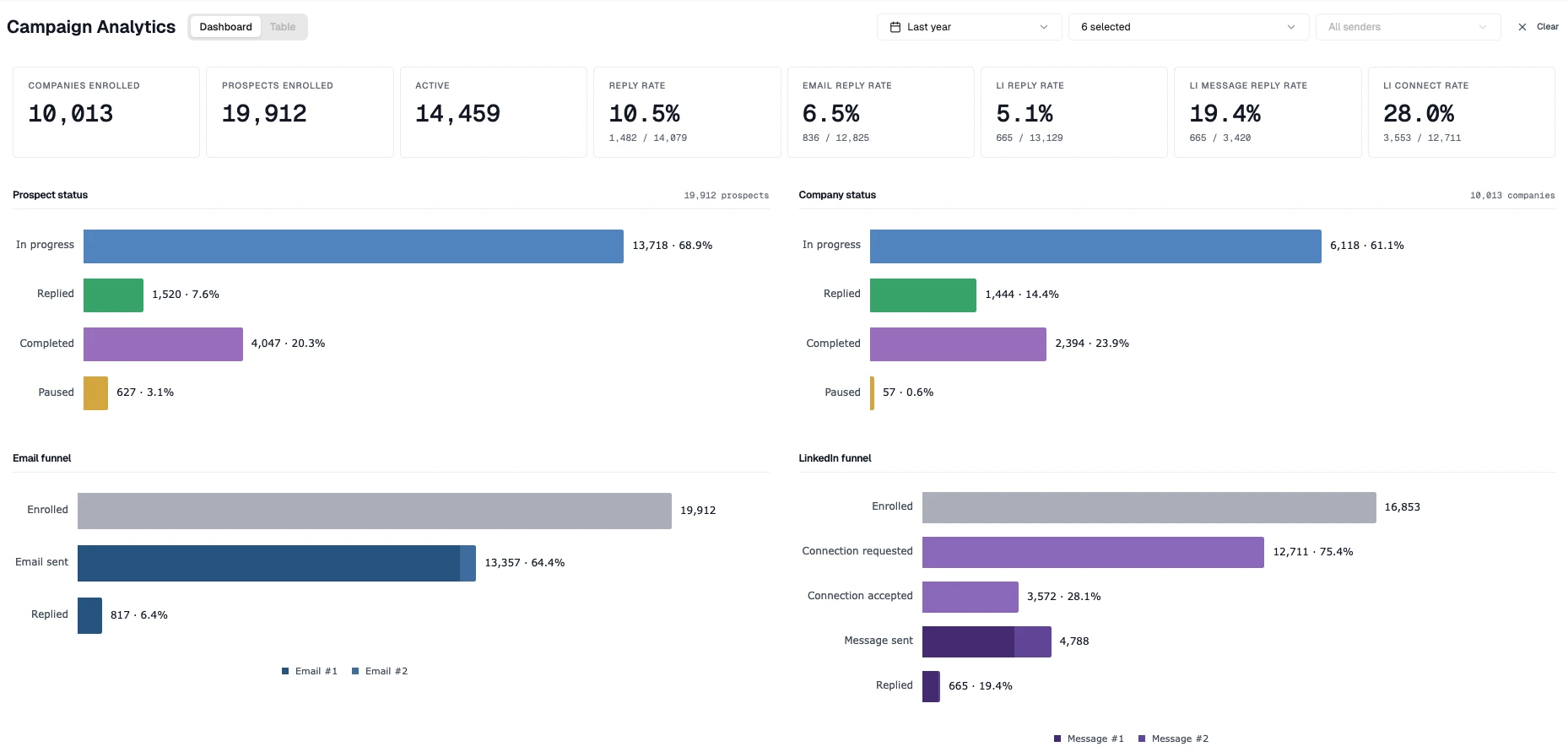
Define the campaign cohort and reporting window before launch. For email, divide unique replying contacts by unique contacts receiving a delivered message. For LinkedIn, use unique contacts sent a message and track connection acceptance separately.
| Measure | Why it matters |
|---|---|
| All replies and interested replies, measured separately | Whether the account selection and offer start relevant conversations |
| Meetings held | Whether interest survives scheduling |
| Scoping discussions with a defined deliverable | Whether conversations progress toward work your practice can perform |
| Qualified opportunities and proposals | Whether a sponsor, approval process and viable scope exist |
| Signed fees and recognized revenue | Whether the pipeline produces commercial work |
| Acquisition cost, partner effort and delivery margin | Whether winning that work is worthwhile |
Count interested contacts once and use the same channel denominator as the overall reply rate. Record useful introductions separately. Link several contacts to one buying account so one engagement does not become several opportunities.
Compare offer, sector, region, stakeholder, channel and outreach approach. Review why scopes failed or were deferred. If meetings repeatedly produce projects below your minimum viable fee, tighten qualification. If proposals stall at finance, improve the business-use and approval discussion before increasing outreach volume. The campaign analytics guide explains how to preserve campaign attribution through later sales stages.
Give your partners a researched reason to approach the next account
Emitree's research and outreach for sustainability advisory practices works from your sector expertise, deliverables, target engagement size and capacity. We combine public sources with the CRM history and private research you share, check relevant contacts and run email and LinkedIn outreach in your voice.
Think of it as pairing your practice with a go-to-market team that has the technical know-how to organize research, qualification, messaging and campaigns. For the price of one junior BDR, our proposition is the work of four across those tasks. Pricing is scoped to your offering, markets and workload. Your partners take the replies with the account research, then lead scoping, delivery commitments and commercial conversations.
Emitree reports 3–7% cold email reply rates and 14–22% LinkedIn reply rates across clients' sustainability campaigns. If your campaigns currently return 0.45% on email and 3% on LinkedIn, measured on the same basis, those ranges are roughly 7–16× and 5–7×, respectively. These are all replies, not sector-specific results or positive-reply rates. Compare rates using the same denominator.
Strong outreach starts with evidence of fit. For consulting, that means checking the deliverable, internal capacity, decision deadline and client sponsor who can approve the work. That is the preparation an expert BDR would do with enough time to research each account. Emitree makes that preparation the default. Automating delivery does not replace this work.
The same service can run new-account campaigns, CRM revival, relationship research and conference outreach. You can inspect the evidence and see which offers, sectors and outreach approaches earn suitable opportunities. Begin with one deliverable your practice wants to sell more often, then use the campaign results to choose where partner time goes next.