How to Sell Water Stewardship and Industrial Reuse Solutions
Estimated reading time: 11 minutes
To sell a water solution, connect a specific offer to the place where a buyer can use it. A replenishment project needs a relevant basin and a credible benefit. A reuse system needs a suitable water stream, an operating use and a viable investment. A corporate water target helps you find accounts; the site and decision qualify them.
Use a different first question for each offer:
| What you sell | Qualify first | Find the person responsible for | Offer a useful next step |
|---|---|---|---|
| Replenishment projects | Basin, intervention, timing, project access and benefit evidence | Corporate water programs and local partnerships | A project brief with location, method and attribution assumptions |
| Stewardship advice or water-risk software | Sites covered, existing assessments, intended workflow and internal users | Water strategy, regional implementation and site data | A review of one site's research or decision process |
| Industrial efficiency or reuse | Source water, intended use, quality, operating constraints and approval route | Plant engineering, operations and capital investment | A defined data review or feasibility assessment |
For a first campaign:
- Select one offer and a delivery territory your team can serve.
- Build a site list and connect each site to its corporate owner and basin.
- Record the evidence for fit and the questions still unanswered.
- Contact the person who can advance the next assessment.
- Track which conversations become technically and commercially viable work.
The market in October 2026
The EPA launched Water Reuse Action Plan 2.0 in April 2026, with industry and technology among its priorities. The Alliance for Water Stewardship launched AWS Standard V3.0 in March 2026, while WRI's September 2025 benefit-accounting guidance gives project teams a framework for quantifying and communicating volumetric benefits. These developments give sellers useful research inputs and diligence requirements. They do not establish a purchase at a particular factory or funding for a particular basin project.
Size the contracts you can serve
Your total addressable market should reflect your revenue model. Replenishment, advice, software and industrial treatment can involve the same corporate group while drawing on different budgets and buying processes.
| Offer | Build the account universe from | Estimate commercial value using | Keep separate |
|---|---|---|---|
| Replenishment | Corporate programs whose basin priorities match projects you can deliver | Potential engagements and realistic sponsor contributions for the agreed scope | Project water benefits, total project finance and your own revenue |
| Advice or software | Buying organizations with sites and workflows your service supports | Eligible buying accounts and scoped annual contract values | Group contracts, individual sites and optional services |
| Industrial reuse | In-territory facilities with a source-and-use combination your technology can assess | Eligible installations, realistic project scopes and service revenue | Capital projects, recurring operations and speculative rollouts |
Use facility directories, company reports, site announcements, project portfolios and your CRM. Apply delivery, application, minimum-project and commercial filters before estimating revenue. A multinational headquarters is a starting point for ownership research, not the location of its water problem.
An illustrative screen might identify 60 sites in your territory, with 12 passing your initial application criteria. If only five have a confirmed review window, keep those five separate from the wider research universe. The example describes a planning method, not observed market demand.
Link sites, operating entities and parent groups. A basin program funded by three sponsors is not three independent sales of the entire project. A corporate contract covering ten factories is not automatically ten buying accounts. Record assumptions about timing and scope so your market model can change when discovery supplies better information.
Start at the site, then test the basin connection
Store the facility coordinates, operating entity, water source, receiving catchment and evidence date. Add the local challenge your offer addresses: supply reliability, seasonal scarcity, discharge constraints, quality, operating costs or a corporate program priority.
WRI's Aqueduct tools offer a starting point for location-based research. Use the risk screen to prioritize investigation, then check the actual source, local conditions and facility operations. A regional score cannot tell you the plant's treatment requirements or purchasing timetable.
Season matters. Ask when the pressure occurs and when the proposed intervention produces a benefit. Keep observed site data separate from modeled exposure and the buyer's stated priorities. Record whether a figure describes water taken into the site, water used in a process, water discharged or an attributed project benefit. Do not substitute one for another when writing a message.
For a replenishment offer, prepare the intervention location, implementation partner, access or landowner agreements, delivery period, calculation method and proposed allocation between sponsors. WRI's VWBA 2.0 guidance addresses local context, quantification, timing and attribution. Distinguish anticipated benefits from delivered benefits. Its volumetric scope also means a volume alone does not establish every water-quality or ecosystem outcome.
For industrial reuse, establish the proposed source and end use before selecting equipment. Request water-quality data, flow and variability, required output quality, storage needs, operating hours, space, energy demand, residuals management and existing infrastructure. Build the economics from the actual supply, treatment, discharge and operating costs. A lower withdrawal figure by itself does not prove a profitable reuse project.
The EPA's October 2026 reuse overview explains that treatment and monitoring depend on the water source and intended use. Its regulatory overview also directs readers to state-specific requirements. Your engineers and the relevant authorities must assess the actual installation.
Keep the local rules attached to the opportunity
| Market | Research task | Boundary to preserve |
|---|---|---|
| EU | Check the country, catchment, source, discharge route and applicable permits | The European Water Resilience Strategy's objective to improve water efficiency by at least 10% by 2030 is non-binding. Confirm the actual duties for each facility. EEA's 2025 assessment |
| UK | Establish the relevant nation, water supplier, tariff, approvals and site responsibilities | England's 2026 water white paper describes reforms and plans to support non-household reuse. A policy plan does not approve an individual project. Defra |
| United States | Check state requirements for the actual source and end use | WRAP 2.0 is a collaborative initiative, not a federal regulatory mandate requiring a corporation to buy your system. EPA |
| Canada | Identify the province, facility authorization, utility relationship and proposed changes | Québec's industrial wastewater guidance identifies an environmental authorization regime for new projects and changes. Confirm the actual route; do not export it across Canada. Québec |
If your offer concerns AWS implementation, verify the particular site's certificate, version and next audit. AWS launched V3.0 with a transition period that still permits specified V2.0 audits and surveillance. A new version does not mean every existing certificate has migrated. AWS transition guidance.
Map the decision beyond the sustainability team
| Person or organization | What to establish | Material that can help |
|---|---|---|
| Corporate water-program owner | Priority basins, eligible interventions, program budget and selection process | A project brief tied to the relevant basin |
| Regional or site environmental lead | Local conditions, permits, monitoring and operational priorities | A site-specific question list |
| Plant engineering and operations | Source data, process compatibility, uptime and operating responsibility | A feasibility scope and data requirements |
| Utility or water supplier | Available supply, quality, connection and service responsibilities | A clear description of the proposed source and use |
| Implementing partner, landowner or catchment organization | Access, local acceptance, delivery and monitoring responsibilities | A responsibility and project-access map |
| Finance, procurement and legal | Investment criteria, contracting entity, rights and approval timing | Scope, assumptions and contract responsibilities |
Research current remits, project documents and professional roles. Then ask how the decision actually works. A water-program manager may select basin partnerships without controlling plant capital expenditure. An environmental manager may hold the necessary data without approving a supplier.
Defer an account when geography, required quality, delivery capability or project rights do not fit. Record unresolved access, attribution and approval questions before assigning an opportunity value. Preserve the reason for rejection so another campaign does not repeat the same approach.
Turn an observed water activity into a useful message
Nestlé's current water disclosure reports 2025 water withdrawal separately from volumetric benefits delivered by Nestlé Waters & Premium Beverages projects. It also describes work with communities, farmers and public authorities. That establishes an active stewardship context. It does not reveal which site needs a new provider or which basin has unallocated funding.
A replenishment developer should narrow that research to the relevant program and a project it can substantiate. An industrial supplier should investigate the individual factory and its operating use.
Illustrative scenario: a fictional manufacturer's report identifies the Ebro basin as a priority. A hypothetical developer with a documented project there could send this unsent message:
Subject: Project fit for your basin program
Your water report identifies the Ebro basin as a priority. We develop groundwater-recharge projects there, with local implementation partners.
Does your water team evaluate additional projects there? I can send the location, implementation plan and proposed benefit-accounting approach for an initial fit review.
Use the basin reference only after verification, and offer only a project your team can document. The message asks about program fit before assuming a funding gap.
For cold outreach to industrial users, start with a specific operating event, such as a documented production-line expansion. Ask whether the water balance is part of that review. Do not calculate unverified demand from the announcement or promise savings before assessing the stream.
Reopen the CRM around the original constraint
Group dormant opportunities by the reason they stopped: unavailable feedwater data, an unsuitable use, capital timing, permit questions, project access, attribution or an incumbent contract. Coordinate with the account owner and check exclusions before contacting anyone.
Illustrative CRM revival message, based on a fictional prior discussion:
Our reuse assessment paused while your team collected water-quality and flow data for the cooling-water stream. Is that information available now?
If so, we can confirm whether the original assessment scope still fits before returning to equipment and price. Should we review that with the plant engineer?
The question continues the actual technical decision. A fresh corporate water target would not resolve the missing data. If the work remains deferred, record the next review point. If it has ended, close the opportunity.
Find connections that remove a qualification barrier
Map catchment organizations, implementation partners, engineering firms, treatment operators, utilities, water advisers and existing customers. Rank each connection on access to a relevant account, knowledge of the current decision, complementary delivery capability and reach across suitable sites.
A local implementation partner with project access may help a replenishment opportunity more than a large list of executives. An engineering firm already reviewing a factory expansion may help establish who owns the water assessment. Verify commercial relationships before asking for an introduction.
Give the introducer a short description of your offer, the relevant place and the question you want to resolve. Agree customer ownership and information-sharing responsibilities. Track a partner introduction separately from direct buyer interest and keep both linked to the account.
Use conferences to reach the relevant water conversation
The AWS Global Water Stewardship Forum convenes practitioners, members and other stakeholders. SIWI's World Water Week brings together science, policy, business and practice. Both can support relationship research, but their broad audiences require careful buyer qualification.
For a future edition, research the program and relevant accounts before booking meetings. Distinguish corporate buyers, implementation partners, technology vendors and public bodies. Confirm whether the contact is attending; a speaker listing or an employer's presence does not establish attendance by the person you want.
Offer a short discussion about a named basin, a documented operating change or a specific assessment question. Give your attending rep the sources and missing qualification facts. Afterward, send the material promised and record the agreed owner and next step. Emitree's conference outreach service connects that preparation and follow-up with the account history.
Measure progress to a project worth delivering
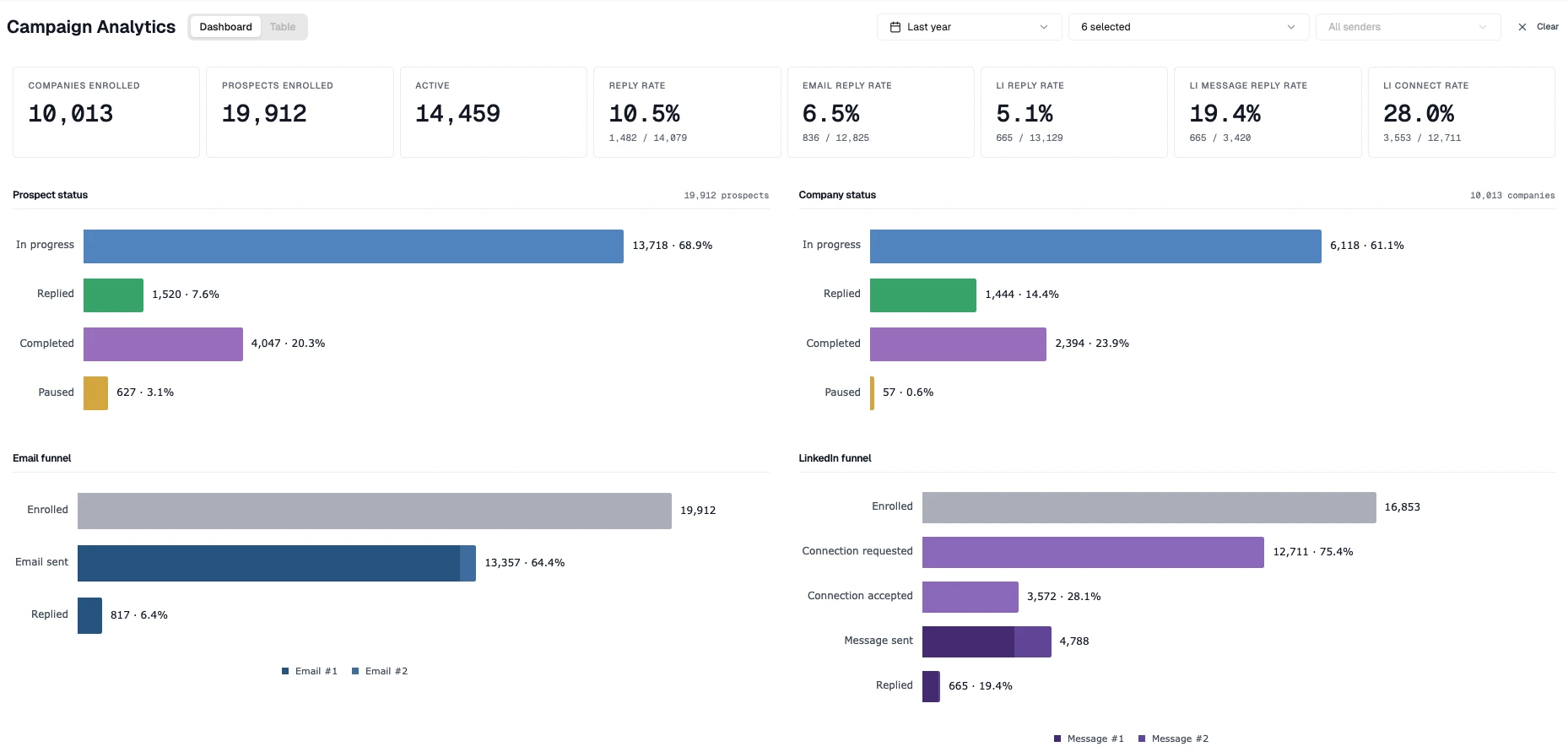
Define the cohort, channel and reporting window before launch. For email reply rates, count unique contacts receiving a delivered message. For LinkedIn, count unique contacts sent a message and track connection invitations separately. Count each contact once within the campaign.
| Measure | What to record | What you learn |
|---|---|---|
| All replies | Replying contacts divided by contacts reached in the same channel | Whether messages start conversations |
| Positive replies | Interested contacts divided by the same denominator; record referrals separately | Whether the offer earns relevant interest |
| Meetings held | Completed conversations, separate from bookings | Whether interest progresses |
| Technical or project reviews | Agreed data reviews, site assessments or basin-project evaluations | Whether buyers commit effort to qualification |
| Qualified opportunities | Confirmed fit, decision owner, commercial scope and next step | Which segments produce viable work |
| Pipeline and won business | Opportunity value, signed work, revenue and acquisition cost as separate measures | Which campaigns justify further investment |
Tag the basin, site type, offer, region, stakeholder, campaign and outreach route. Preserve the first campaign and later conference or referral touches. Deduplicate corporate programs and multi-site projects. Keep projected water benefits separate from commercial pipeline value.
Review loss and deferral reasons alongside wins. If plant conversations fail at data access, improve qualification. If basin projects fail selection because their timing or attribution does not fit, change the offer or target program. Compare cohorts with similar time to complete the assessment. The campaign analytics guide explains the broader reporting process.
Add technical research and outreach capacity beside your sales team
Emitree's water stewardship research and outreach service starts with your offering, delivery territory and evidence requirements. We combine public sources with your CRM history and permitted private research, check relevant contacts, and run email and LinkedIn campaigns in your voice. New accounts, CRM revival, useful connections and conference campaigns share the same account context.
For the price of one junior BDR, our proposition is the work of four across research, qualification, messaging and outreach. Pricing is scoped to your offer, markets and workload. You get a go-to-market team with technical know-how paired with your sales team. When a prospect replies, the sequence pauses and your reps receive the research and conversation history. They handle meetings, specialist assessment and closing.
Emitree reports 3–7% cold email reply rates and 14–22% LinkedIn reply rates across clients' sustainability campaigns. If your campaigns currently return 0.45% on email and 3% on LinkedIn, measured on the same basis, those ranges are roughly 7–16× and 5–7×, respectively. These are all replies, not sector-specific results or positive-reply rates. Compare rates using the same denominator.
Strong outreach starts with evidence of fit. For water solutions, that means checking the site or basin, operational constraints, project timing and people responsible for implementation. That is the preparation an expert BDR would do with enough time to research each account. Emitree makes that preparation the default. Automating delivery does not replace this work.
Dependable intelligence gives your team an accurate account of the site, its relevance and the questions still to answer. Campaign reporting shows which basins, segments, industries and outreach approaches deserve further effort. Start with one offer and one clearly defined set of sites or programs. Let the evidence determine where the next campaign goes.